
Quick answer: Construction cost codes are standardized labels that sort every project cost, labor, material, equipment, and subcontractor work, into a specific category of work so budgets can be tracked against actual spend. Most contractors base their system on CSI cost codes (the Construction Specifications Institute's MasterFormat), then build their own job cost codes underneath it to match how their crews actually work.
Without a coding system, every expense lands in the general ledger as one number per job. Nobody can tell whether an overrun came from framing, electrical, or a change order that never got logged. Cost codes break the job into pieces small enough to actually manage.
Key Takeaways
- Cost codes assign every dollar to a category of work: so you can compare budget to actual by task, not just by job.
- CSI cost codes are the standard starting point: a numbering system with divisions like 03 Concrete or 26 Electrical.
- Job cost codes are your own layer on top: built around how your crews, phases, and vendors actually work.
- Coding has to happen at the point of purchase: code it after the fact and the data is already stale.
- Too many codes backfires: crews stop coding accurately, or skip it, when the list gets too long to use in the field.
Why Construction Cost Codes Matter for Job Costing
Construction cost codes matter because they turn one lump job total into a set of categories a project manager can actually act on. A $40,000 overrun on a job shows up as a single bad number without codes. With codes, that same overrun points straight at "03 Concrete" or "23 HVAC," and someone can catch it before the next draw goes out.
This is the backbone of job costing, the practice of matching every dollar spent to the specific task or phase that caused it. Knowing the different expense types for construction companies is the first step before you can code them consistently. Cost codes are what make job costing possible in the first place; without them, there is nothing to sort costs into.
For contractors managing spend across several active job sites at once, a consistent coding structure is also what makes construction expense management work at scale instead of falling apart the moment a company grows past a handful of jobs.
CSI Cost Codes vs Job Cost Codes: What's the Difference?
CSI cost codes are the standardized numbering system published by the Construction Specifications Institute, known as MasterFormat. MasterFormat organizes construction work into roughly 50 divisions, from 03 Concrete to 26 Electrical to 32 Exterior Improvements, so architects, estimators, and contractors across the industry describe the same scope of work the same way.
Job cost codes are the codes a contractor actually uses day to day. Most companies start with CSI divisions, then trim, combine, or extend them to fit how their own crews, phases, and vendors work. A residential framer does not need 50 divisions; a commercial GC running mechanical, electrical, and plumbing subs on the same job might need more granularity than MasterFormat provides out of the box.
The two are not competing systems. CSI cost codes give you a shared vocabulary; job cost codes are what you build with it.
The Standard Construction Cost Codes List (Full List)
The table below covers the CSI MasterFormat divisions most general contractors and subs actually use for job costing. Not every company needs all of them. Most residential and light commercial contractors work from a shortlist of 10 to 15.
| Code | Division | Typical Costs Covered |
|---|---|---|
| 01 | General Requirements | Permits, supervision, temporary facilities |
| 02 | Existing Conditions | Demolition, site survey, hazmat |
| 03 | Concrete | Footings, slabs, foundations |
| 04 | Masonry | Block, brick, stone |
| 05 | Metals | Structural steel, framing |
| 06 | Wood, Plastics, Composites | Rough and finish carpentry |
| 07 | Thermal and Moisture Protection | Insulation, roofing, waterproofing |
| 08 | Openings | Doors, windows, glazing |
| 09 | Finishes | Drywall, paint, flooring |
| 21 | Fire Suppression | Sprinklers, alarms |
| 22 | Plumbing | Fixtures, piping, water heaters |
| 23 | HVAC | Ductwork, units, controls |
| 26 | Electrical | Wiring, panels, lighting |
| 31 | Earthwork | Grading, excavation |
| 32 | Exterior Improvements | Paving, landscaping, fencing |
How to Build a Job Cost Code Structure for Your Projects
A usable job cost code structure starts narrow and grows only when the data proves you need more detail.
- Start with CSI divisions as the backbone, so estimates and job costs speak the same language.
- Add a phase layer under each division (rough-in, finish, punch list) if your projects run long enough to need it.
- Split codes by cost type: labor, material, equipment, and subcontract, so you can see not just what a division cost but why.
- Cap the total list at a size your field crews will actually use. Twenty to forty active codes is realistic; two hundred is not.
- Push coding to the point of purchase instead of month-end. Software built for advanced job costing and profitability tracking can apply the right code automatically as a card swipe or receipt comes in, instead of relying on someone re-keying it weeks later.
Common Construction Cost Code Mistakes That Wreck Job Costing
Most bad job costing reports trace back to a handful of coding mistakes, not bad accounting.
- Too many codes: crews facing a 200-line list stop coding accurately, or skip it and dump everything into "miscellaneous."
- Coding after the fact: receipts pile up in a truck console until month-end, and by then nobody remembers which job a $40 hardware run was for.
- Inconsistent codes across jobs: "concrete" on one project doesn't match "concrete" on another, so cross-project reporting breaks and estimating loses its baseline.
- No mobile capture in the field: a crew lead without a phone-friendly way to code a receipt on-site either guesses later or hands it off to the office to sort out.
Keeping Construction Cost Codes Accurate in the Field
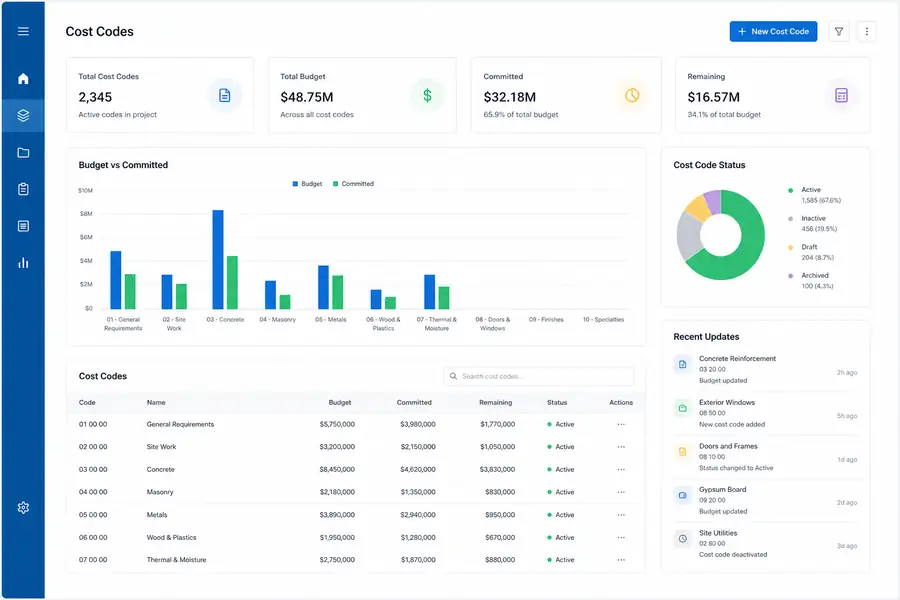
A coding structure only works if it holds up on a job site, not just in a spreadsheet at the office. Field crews need a way to snag a receipt at a lumber yard or gas station, attach it to the right job and code in a few taps, and move on. Clyr handles this by capturing card and receipt spend in real time and coding it as it happens, then syncing coded costs straight into QuickBooks so nobody re-keys the same transaction twice. If you want to see how that looks against your own cost code list, you can book a demo.
FAQs
What are construction cost codes?
Construction cost codes are standardized labels that assign every project cost, labor, material, equipment, or subcontractor charge, to a specific category of work. They let a contractor compare what was budgeted for a task against what was actually spent, instead of only tracking one total per job.
What is the difference between CSI cost codes and job cost codes?
CSI cost codes are the industry-standard numbering system published by the Construction Specifications Institute (MasterFormat), organized into roughly 50 divisions like concrete, electrical, and HVAC. Job cost codes are the version a contractor actually uses day to day, usually built from CSI divisions but trimmed or extended to fit how their own crews and jobs run.
How many cost codes should a construction company use?
Most residential and light commercial contractors work well with 20 to 40 active codes. Fewer than that usually cannot separate labor from material well enough to catch overruns, and far more than that tends to get skipped by field crews under time pressure.
Are CSI cost codes required by law?
No. MasterFormat is an industry convention, not a legal requirement, but most estimating software, general contractors, and specialty subs use it because it gives everyone a shared way to describe the same scope of work.
Can construction cost codes sync with QuickBooks?
Yes, most job costing and expense tools let you map cost codes to QuickBooks classes or job types so coded transactions land in the right place automatically. This avoids someone manually re-entering the same job cost data in two systems.