
Managing expenses used to mean juggling spreadsheets, chasing receipts, and hoping for the best at tax time. However, by 2025, that approach will not only be outdated but also expensive.
Every hour and dollar counts for small businesses operating with lean teams and tighter margins. Yet, too many are losing to clunky processes and scattered systems.
What if your expense management tool could not only save time but also actively fuel your business growth?
This guide isn’t about features for the sake of features. It’s about why smart, modern expense management is becoming essential for survival, and a powerful lever for scaling smarter.
From the rise of AI and real-time tracking to industry-specific wins, we’ll show you how to move beyond admin and into strategy.
If you’re ready to stop treading water and start building a business with financial clarity, you’re in the right place.
Let’s dive in.

The Financial Reality for Small Businesses in 2025
Lean teams, growing complexity
In 2025, small businesses will face tighter margins and rising overhead. A report by Chartered Accountants Ireland found that 77% of SMEs saw rising costs, with staff-related and operational expenses topping the list. Remote work has only increased the complexity, with scattered expense data across emails, spreadsheets, and apps.
Manual processes are bleeding time and money
It costs $58 to process a single expense report manually, and 19% of reports contain errors, each costing an average of $52 to fix. For a company processing 50 monthly reports, over $41,000 annually is lost to inefficiencies.
Why the shift is happening now
Businesses are realizing manual tracking isn’t just outdated, it’s expensive and risky. Delayed reimbursements frustrate staff, and poor visibility into spending makes it hard to budget or stay compliant.
That’s why more teams are embracing automation: real-time tracking, error reduction, and policy compliance are becoming essentials, not extras.
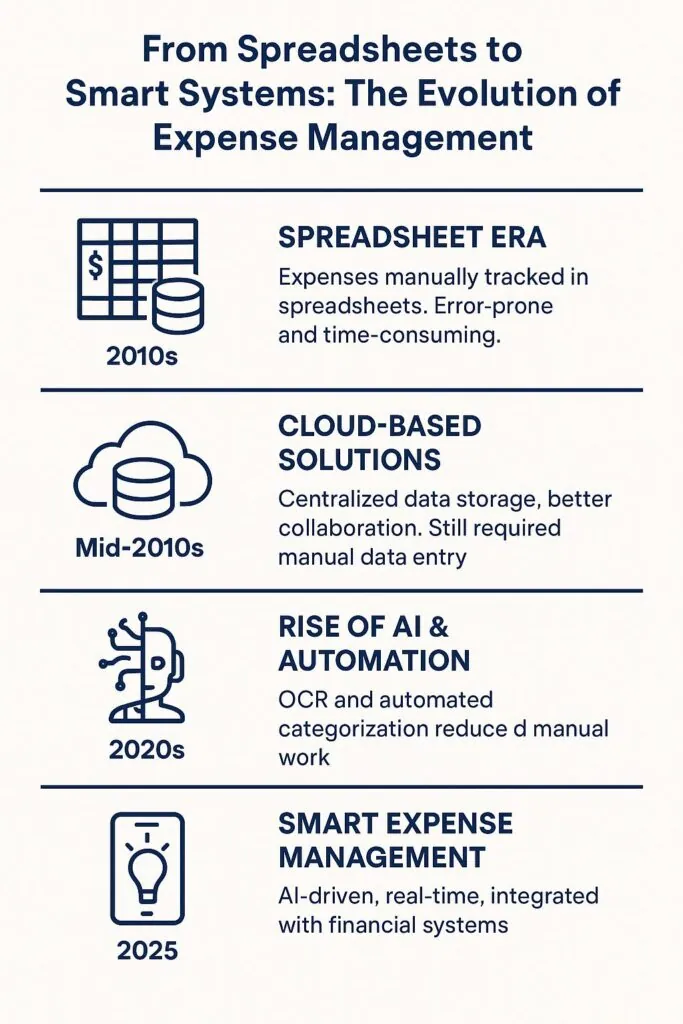
From Spreadsheets to Smart Systems: The Evolution of Expense Management
2010s: The Spreadsheet Era
In the early 2010s, small businesses primarily relied on spreadsheets for expense tracking. While spreadsheets offered a step up from paper-based methods, they were still prone to errors, time-consuming, and lacked real-time visibility.
Employees manually entered expenses, and finance teams spent considerable time reconciling data and ensuring compliance.
Mid-2010s: Introduction of Cloud-Based Solutions
As technology advanced, cloud-based expense management tools emerged, offering centralized data storage and accessibility.
These solutions allowed for better collaboration among teams, automated some processes, and provided more accurate reporting. However, many systems still required manual data entry and lacked integration with other business tools.
2020s: Rise of AI and Automation
The 2020s marked a significant shift in integrating Artificial Intelligence (AI) and automation into expense management.
AI-powered tools began automating data entry through Optical Character Recognition (OCR), categorizing expenses, detecting policy violations, and providing real-time analytics. This transition not only reduced manual workload but also enhanced accuracy and compliance.
2025: The Era of Smart Expense Management
By 2025, expense management will have evolved into a smart, integrated system that leverages AI, machine learning, and mobile technology. Key features include:
- Automated Data Capture: Receipts are scanned and processed instantly using OCR, eliminating manual entry.
- Real-Time Policy Enforcement: Expenses are checked against company policies in real time, ensuring compliance.
- Predictive Analytics: AI analyzes spending patterns to forecast future expenses and identify cost-saving opportunities.
- Mobile Accessibility: Employees can manage expenses on-the-go through mobile apps, increasing efficiency and convenience.
- Integration with Financial Systems: Seamless integration with accounting and ERP systems ensures accurate financial reporting.
This evolution reflects a broader trend towards digitization and automation in business processes, enabling small businesses to operate more efficiently and make informed financial decisions.
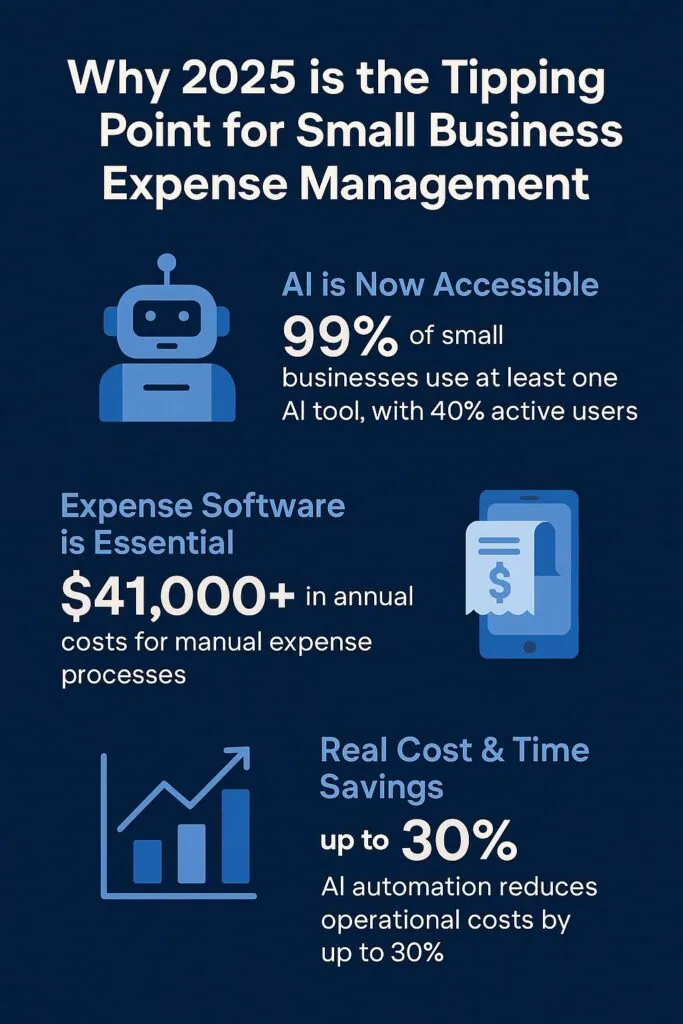
Why 2025 Is the Tipping Point for Small Business Expense Management
AI Is Now Accessible to Small Businesses
In 2025, artificial intelligence (AI) will no longer be exclusive to large enterprises. A recent report indicates that 99% of U.S. small businesses now utilize at least one AI platform, with 40% identifying as active users, nearly doubling from 23% the previous year. Moreover, 91% of these businesses believe AI will contribute to their future growth.
Real Numbers: Time Saved, Error Reductions, and Cost Benefits in 2025
Implementing AI-driven expense management systems can lead to significant savings:
- Operational Cost Reduction: Businesses adopting AI automation can reduce operational costs by 20-30%.
- Efficiency Improvement: AI can improve efficiency by over 40%, streamlining processes and reducing manual workload.
- Productivity Boost: Small companies using AI have reported productivity increases ranging from 27% to 133%, depending on the application.
Introducing the Stakes, Not Just the Tools
The shift towards AI-powered expense management is not merely about adopting new tools; it’s about staying competitive and efficient in a rapidly evolving business landscape. Small businesses that embrace these technologies position themselves for growth, while those that don’t risk falling behind.

Features That Matter, and What to Ignore
Key Features That Drive Value
Modern expense management software offers a range of features designed to streamline financial processes and enhance efficiency. For small businesses, the following functionalities are particularly beneficial:
- Real-Time Tracking: Enables immediate logging of expenses, reducing errors and providing up-to-date financial data. This feature allows businesses to monitor spending as it happens, facilitating better budget control and decision-making.
- Optical Character Recognition (OCR): Automates data entry by extracting information from scanned receipts, minimizing manual input and associated errors. OCR technology enhances accuracy and saves time in processing expenses.
- Integration with Financial Systems: Seamless connectivity with accounting software, bank accounts, and credit cards ensures synchronized data across platforms, reducing duplication and improving financial oversight.
- Policy Compliance and Automated Approvals: Enforces company expense policies automatically, flagging non-compliant entries and streamlining the approval process. This ensures adherence to internal controls and regulatory requirements.
- Mobile Accessibility: Provides employees with the ability to capture and submit expenses on-the-go through mobile applications, increasing convenience and timeliness in expense reporting.
These features collectively contribute to improved accuracy, efficiency, and compliance in managing business expenses.
Red Flags in Outdated or Overbuilt Software
While advanced features can enhance functionality, certain characteristics may indicate that an expense management system is outdated or unnecessarily complex:
- Lack of Integration Capabilities: Inability to connect with existing financial systems can lead to data silos and increased manual work, hindering efficiency.
- Complex User Interface: Overly complicated interfaces can overwhelm users, leading to errors and decreased adoption rates among employees.
- Limited Mobile Support: Absence of robust mobile functionality restricts the flexibility of employees to manage expenses remotely, which is increasingly important in modern work environments.
- Inadequate Compliance Features: Failure to enforce expense policies or provide audit trails can expose the business to compliance risks and potential financial discrepancies.
Recognizing these red flags is crucial in selecting a system that aligns with the operational needs and capabilities of a small business.
The Importance of Usability Over Feature Bloat
For small businesses, the usability of expense management software is paramount. A system overloaded with features may offer extensive capabilities, but can be counterproductive if it complicates the user experience. Key considerations include:
- Intuitive Design: A user-friendly interface ensures that employees can navigate the system with minimal training, promoting widespread adoption.
- Customization Options: The ability to tailor the system to specific business needs without unnecessary complexity enhances relevance and efficiency.
- Scalability: As the business grows, the software should accommodate increased demands without requiring a complete system overhaul.
Prioritizing usability ensures that the software serves as a tool for simplification rather than an additional challenge.

Use Cases That Prove the ROI
Construction: Streamlining Project Management
Challenge: A global construction materials company faced inefficiencies in managing indirect spend, leading to increased costs and project delays.
Solution: Implementing comprehensive construction management software streamlined procurement workflows, enforced corporate purchasing policies, and provided real-time spend visibility.
Results:
- 11% reduction in indirect spending, saving $7.4 million.
- Achieved an impressive 17:1 ROI on the software investment.
Field Services: Enhancing Operational Efficiency
Challenge: Field service companies often struggle with paper-based processes, leading to delayed billing and inefficient work order management.
Solution: Adopting field service management software enabled real-time tracking, automated scheduling, and mobile access for technicians.
Results:
- Companies reported achieving 300%+ ROI in the first year.
- Significant improvements in billing speed and work order accuracy.
Nonprofits: Improving Data Management and Reporting
Challenge: A large human services nonprofit lacked detailed client insights, hindering its ability to generate funder reports and expand services.
Solution: Implementing robust case nonprofit management software provided centralized data storage, standardized data entry, and streamlined reporting capabilities.
Results:
- Generated an annual return of $1.97 million.
- Achieved a 476% ROI over three years.
- Enhanced service delivery and secured better funding opportunities.
Property Management: Automating Maintenance and Operations
Challenge: Property managers faced challenges with manual maintenance scheduling, leading to increased costs and tenant dissatisfaction.
Solution: Utilizing property maintenance software, automated scheduling, tracked maintenance activities, and provided predictive maintenance capabilities.
Results:
- Reduced maintenance scheduling time by 83%.
- Decreased tenant communication time by 67%.
- Achieved a 20-30% reduction in administrative time, allowing staff to focus on strategic initiatives.
These case studies illustrate the tangible benefits of adopting modern expense and operations management solutions across various industries.
By leveraging technology, organizations can achieve significant cost savings, improve efficiency, and enhance service delivery.

Building the Right Stack: How to Choose the Right Solution
Selecting the appropriate expense management software is crucial for small businesses aiming to streamline operations and support growth. Here’s a guide to making an informed choice:
1. Evaluate Cost vs. Value
- Total Cost of Ownership: Consider not just the subscription fees but also implementation, training, and potential upgrade costs.
- Return on Investment (ROI): Assess how the software can save time, reduce errors, and improve compliance, leading to significant cost savings over time.
2. Prioritize Ease of Use
- User-Friendly Interface: A straightforward, intuitive design ensures quicker adoption and reduces training time.
- Mobile Accessibility: Ensure the software offers robust mobile features, allowing employees to manage expenses.
3. Assess Support and Customer Service
- Responsive Support: Look for vendors that offer timely and helpful customer service, including multiple support channels.
- Training Resources: Access to tutorials, webinars, and documentation can facilitate smoother onboarding and ongoing use.
4. Check Integration Capabilities
- Compatibility with Existing Systems: Ensure the software integrates seamlessly with your current accounting, payroll, and ERP systems to avoid data silos and duplication.
- API Availability: An open API allows for custom integrations, providing flexibility as your business needs evolve.
5. Trial with Your Team
- Pilot Testing: Before full-scale implementation, conduct a trial run with a cross-section of your team to gather feedback on usability and functionality.
- Iterative Feedback: Use insights from the trial to make necessary adjustments and ensure the software meets your team’s needs.
6. Ensure Scalability
- Growth Accommodation: Choose a solution that can scale with your business, handling increased users, transactions, and complexity without performance degradation.
- Feature Expansion: Opt for software that offers modular features, allowing you to add functionalities as your requirements grow.
By carefully considering these factors, small businesses can select an expense management solution that not only meets current needs but also supports future growth and efficiency.
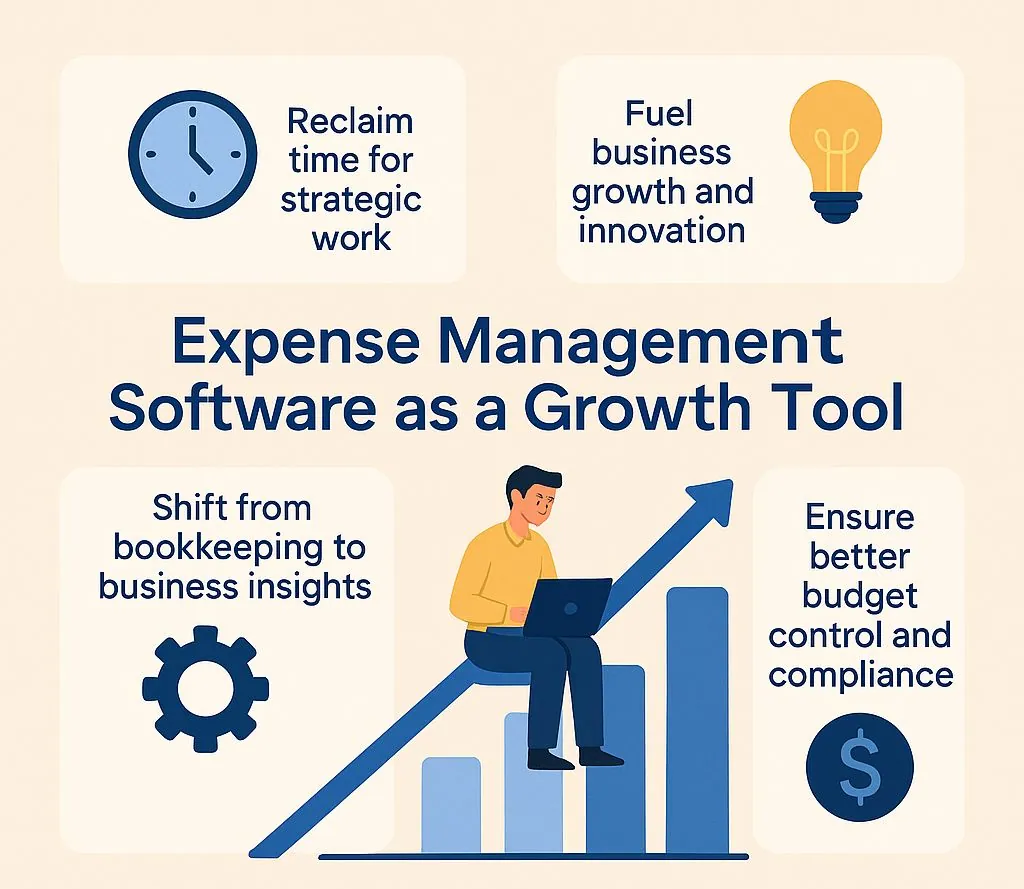
Final Take: Expense Management as a Growth Lever
In 2025, expense management software has evolved beyond its original purpose. It’s no longer just a tool for organizing receipts or speeding up reimbursements; it’s a strategic asset.
By automating manual tasks, eliminating errors, and delivering real-time financial visibility, modern platforms free up your most valuable resource: time. Time that can now be redirected toward growth-focused activities like strategic planning, hiring top talent, or launching new services.
More importantly, smart expense management encourages a shift in mindset, from reactive accounting to proactive financial leadership. Instead of scrambling to make sense of past costs, business owners can now plan with precision, invest with confidence, and scale sustainably.
In a competitive market, the ability to control spend while staying agile isn’t just a financial advantage; it’s a growth engine. It’s time to stop thinking of expense software as a back-office tool and start recognizing it as a front-line driver of business success.
FAQs
Processing a single expense report by hand costs about $58, and 19% of reports contain errors that cost an average of $52 each to fix. For a company handling 50 reports a month, that adds up to more than $41,000 lost to inefficiency every year.
Five carry the weight: real-time tracking, OCR that pulls data straight off receipts, integration with your accounting and banking systems, automated policy compliance and approvals, and mobile access so expenses get submitted on the spot rather than at month-end.
No integration capability, which creates data silos and manual rework. An overly complex interface that kills adoption. Weak mobile support. And inadequate compliance features, meaning the system cannot enforce policies or produce audit trails.
AI-driven automation typically cuts operational costs by 20 to 30%, improves efficiency by over 40%, and lifts productivity anywhere from 27% to 133%. Documented case studies reach further: 17:1 ROI in construction, 300%+ in the first year for field services, and 476% over three years for a nonprofit.
Weigh total cost of ownership against measurable ROI, prioritize an interface people will actually use, check support quality and training resources, confirm integrations and API availability with your existing stack, pilot it with a cross-section of your team, and make sure it scales as headcount and transaction volume grow.