What Is Job Costing? Definition and Example
Job costing is a method of tracking costs by job: every hour of labor, material purchase, subcontractor bill and equipment charge is recorded against the specific project that caused it, usually with a share of overhead added. The result shows what each job really cost and whether it made money.
A remodeling company that finishes two kitchens in one month, each for about $55,000, sees one combined number on its monthly profit and loss statement, while job costing shows that one kitchen earned $9,000 and the other barely broke even.
What job costing means in practice
Most small businesses look at profit for the whole company, month by month. That works when every sale looks alike. It stops working when each job is different, because a good job and a bad one blend into an average that describes neither.
Job costing gives every job its own small profit and loss statement. The contract price goes on one side, every cost the job caused goes on the other, and the difference is that job's profit. Over a year, those results show which kinds of work, customers and estimates make money.
It fits any business that sells custom work in separate units: builders and remodelers, HVAC and plumbing companies, landscapers, event producers, and property managers running unit turns (readying a vacant unit for the next tenant) or capital projects. A plant that makes the same product all day usually uses process costing instead, which averages costs over everything produced. Our comparison of job costing vs process costing covers how to tell which one fits, and the guide to job costing for contractors walks through setting up a system in a construction company.
What goes into the cost of a job
A job's cost has five parts. The first four are direct costs, meaning you can point to the job that caused them. The fifth is a share of everything else.
Direct labor
These are the hours your own crew spends on the job, priced at what those hours really cost. That's the wage plus labor burden: the employer's payroll taxes, workers' compensation insurance and benefits that come with every paid hour. Leave burden out and every job looks more profitable than it was.
Materials
Everything bought for the job counts: lumber, fixtures, wire, pipe, parts pulled from the van. Returns come back off the job as a credit. Stock taken from your own shop counts too, at what you paid for it.
Subcontractors
These are the outside trades you hire for part of the work, such as an electrician or a drywall crew. Record the full amount each sub bills, even when you hold back retainage, the portion withheld until the work is accepted. You still owe it, so it's still part of the job.
Equipment
Rented equipment is simple: the rental invoice goes to the job. Equipment you own, such as a skid steer or a lift, is often charged to jobs at an internal hourly or daily rate. That rate covers the machine's depreciation (its cost spread over its useful life), fuel, repairs and insurance.
Applied overhead
Office rent, the estimator's salary, insurance and software don't belong to any one job, but every job leans on them. Applied overhead is each job's share, added through an overhead rate.
How overhead gets applied to jobs
Overhead is applied with a rate set before the year starts, because the real figures aren't known until it ends. The formula in OpenStax's managerial accounting textbook is estimated overhead divided by the expected level of activity. For a contractor, the activity is often field labor hours.
Say a plumbing and HVAC company expects $240,000 of overhead next year and 12,000 hours of field labor. Its rate is $240,000 / 12,000 = $20 per field labor hour. A job that uses 300 crew hours picks up $6,000 of applied overhead.
Actual overhead never lands exactly on the estimate. If the crews log the planned 12,000 hours but overhead comes in at $252,000, the company applied $12,000 too little. That's called underapplied overhead, and spending less than you applied is overapplied overhead. In the simple method shown in OpenStax's section on under- and overapplied overhead, the difference is cleared to cost of goods sold at year-end.
Cost of goods sold is the line on the profit and loss statement that holds the cost of the work you sold. Bigger companies, or those with larger differences, may split it among unfinished work, finished work and cost of goods sold.
Some small contractors skip applied overhead. They judge each job on gross profit, price minus direct costs, and then check that the year's total gross profit covers overhead. That works too. Just compare every job on the same basis.
How job costing works, step by step
- Open a job number and load the estimate as the job's budget, split by cost code. Cost codes are labels for types of work, such as framing or electrical rough-in, and our post on construction cost codes lists the standard ones.
- Code every cost to the job and cost code when it happens: timesheet hours, vendor bills, card purchases and employee reimbursements.
- Count committed costs as well. A signed subcontract or an open purchase order, a written order sent to a supplier, is money you'll spend even if the bill hasn't arrived yet.
- Compare estimate to actual every week while the job runs. An overrun you spot in week two can still be fixed or billed as a change order, a signed change to the job's scope and price.
- Close the job, review where it missed, and carry the real numbers into your next estimate.
Worked example: a kitchen remodel, estimate vs actual
A remodeling company signs a kitchen remodel for $58,000. It prices labor at a burdened $48 an hour ($32 in wages plus 50% burden) and applies overhead at $20 per field labor hour. Here's the job at closeout:
| Cost | Estimate | Actual | Difference |
|---|---|---|---|
| Direct labor | $15,360 (320 hours) | $17,088 (356 hours) | +$1,728 |
| Materials | $14,200 | $15,050 | +$850 |
| Subcontractors | $9,800 | $10,450 | +$650 |
| Equipment and dumpster | $1,100 | $1,240 | +$140 |
| Applied overhead | $6,400 | $7,120 | +$720 |
| Total job cost | $46,860 | $50,948 | +$4,088 |
| Profit on $58,000 | $11,140 (19.2%) | $7,052 (12.2%) | -$4,088 |
The job still made money, just $4,088 less than planned. Job costing shows where it went.
Labor is the biggest piece. The crew took 36 extra hours. Each one cost $48 of burdened labor and absorbed another $20 of applied overhead, which is an allocation rather than new spending. That's $2,448 ($1,728 + $720), about 60% of the miss. The crew lead's daily notes should explain it: rework, a wait for an inspection, or rotted subfloor found during demolition.
Materials and subcontractors are a different problem. The $850 was a cabinet hardware upgrade the homeowner chose mid-job, and the $650 was the plumber moving a drain line at the homeowner's request. Both changed the scope, and neither became a written change order, so $1,500 of extra work went unbilled. The last $140 was an extra dumpster haul. Our guide to construction change orders covers pricing them and getting sign-off before the work starts.
The next estimate for a similar kitchen should carry more labor hours, and the project manager should write change orders on the spot. Run that review on every closed job and your estimates stop repeating the same misses.
Tracking job costs day to day
The arithmetic is easy. The hard part is getting every cost onto the right job while someone still remembers what it was for. A receipt that rides around in a truck for three weeks tends to get coded to overhead, and the job looks cheaper than it was.
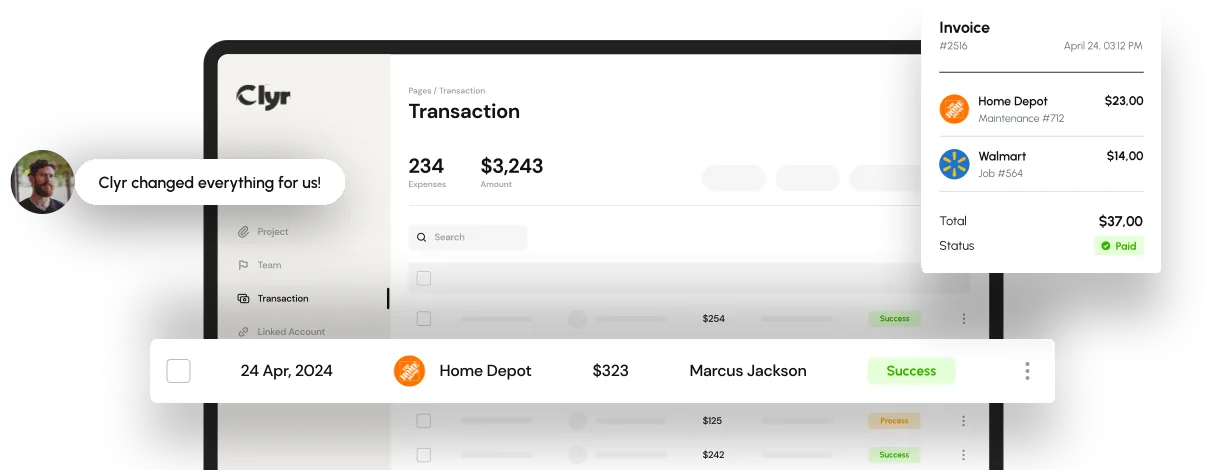
Clyr covers the spend side. A tech swipes one of the cards you already have, Clyr texts them, and they reply with a photo of the receipt. Every card swipe, bill and reimbursement lands on the right job and cost code while the crew is still on site, which feeds budget versus actual by job. Labor hours aren't part of that, so they come from your own time-tracking or payroll system.
FAQs
Costing every $250 repair call in full can take more time than it saves. A practical middle ground is to job cost installs and replacements in full and track small calls by type. Compare the average cost of, say, a water heater swap with the flat-rate price you charge for it. If the average cost creeps up, the price or the process needs a look.
They go to overhead: the shop lease, office staff, the general liability policy. A useful test is whether you would have spent the money if the job didn't exist. If yes, it's overhead. One purchase that serves several jobs is different. A single supply-house run for three jobs should be split across the three by line, not parked in overhead because splitting is a nuisance.
The property, unit or project plays the role of the job. A unit turn, a roof replacement or a parking lot repaving each gets its own budget, and costs are coded to the property and unit. Billable work then goes to the owner on the owner statement, the monthly report to each property owner. The questions match a contractor's: did this cost what we budgeted, and did everything billable reach the owner?
No. Cost accounting is the broader practice of measuring what things cost inside a business so managers can price, plan and control spending. Job costing is one method within it, used when work comes in separate, different jobs. Process costing is another. Activity-based costing is a way to assign overhead using several cost drivers, such as truck rolls or permits pulled, instead of one overhead rate.