T&M Meaning: What Is a Time and Materials Contract?
T&M, short for time and materials, is a type of contract where the customer pays for the hours actually worked at agreed hourly rates, plus the actual cost of materials, often with a set markup. Many set a not-to-exceed cap, and contractors use T&M when nobody can price the work accurately before it starts.
When half a warehouse loses power and nobody knows what failed until the panel is open, the electrical contractor quotes $118 an hour for a journeyman (a fully trained electrician), materials at cost plus 15%, and a promise to call before the bill passes $7,500.
What T&M means in practice
The usual alternative is a fixed price, also called a lump sum: the contractor names one number and eats any overrun. With T&M, the customer pays for whatever the job actually takes.
That moves the risk to the customer. A slow day, a second supply-house run or a problem behind the drywall all show up on the bill. In exchange, the customer doesn't pay a padded price built to cover surprises that may never happen.
T&M fits work you can't see before you start: hidden damage, emergency calls, troubleshooting and demolition in old buildings. It also shows up inside fixed-price jobs, when a crew finds rotted framing nobody could have priced and the owner agrees to do that piece on T&M with a cap. Our guide to construction change orders covers getting extra work approved before the crew starts.
How T&M pricing works
A T&M contract or work order fixes the hourly rates, the way materials are charged and the cap in advance. The hours and costs come later.
Labor rates
The hourly rate on a T&M job is a billing rate, not a wage. It has to cover the worker's pay, the labor burden that comes with it (payroll taxes, workers' compensation insurance and benefits), a share of company overhead such as trucks, tools and the office, and profit.
For the electrician above, a $118.00 journeyman rate might break down as $42.00 of wages, $14.70 of labor burden, $40.00 of overhead and $21.30 of profit. Each type of worker gets its own rate. The contract should also say how overtime and weekend work are charged, and whether time is billed in quarter-hour or half-hour steps.
Material markup
Materials are usually billed at what the contractor paid, plus a markup percentage written into the contract. The markup pays for sourcing and picking up parts, handling returns, and fronting the money until the customer pays. Equipment rentals, dump fees and subcontractor invoices may be billed at cost or with a markup, and the contract should say which.
A 15% markup is not a 15% profit. Marking up $1,000 of parts by 15% bills $1,150, and the $150 is about 13% of that price. Mixing up markup vs margin is an easy way to underprice a job.
Not-to-exceed caps
A not-to-exceed (NTE) amount is the most the customer agrees to pay without a new approval. It doesn't turn the job into a fixed price: if the work comes in under, the customer pays less. Near the cap, the contractor stops and asks, and the customer either raises the cap in writing or agrees on a stopping point. Agree in advance when that call comes, say at 80% of the cap, so it doesn't arrive after the money is spent.
Worked example: a T&M invoice
The warehouse repair took a journeyman and an apprentice 22 hours each over three days, plus a scissor lift to reach the main power cable along the ceiling. The NTE was $7,500.
| Line | Detail | Amount |
|---|---|---|
| Journeyman electrician | 22 hours x $118.00 | $2,596.00 |
| Apprentice electrician | 22 hours x $72.00 | $1,584.00 |
| Materials at cost | Wire, conduit, breaker, fittings (supplier invoices attached) | $1,860.00 |
| Material markup | 15% x $1,860.00 | $279.00 |
| Scissor lift rental | 2 days, at cost (rental agreement attached) | $410.00 |
| Invoice total | $6,729.00 | |
| Left under the $7,500 NTE | $771.00 |
At the 80% point, $6,000.00, the contractor called and the owner agreed to continue. Sales tax on materials and rentals depends on the state, so it's left out here.
The records a customer will ask for
A customer paying by the hour has every reason to check the hours. If you're the contractor, expect to be asked for these on bigger jobs:
- Daily time tickets listing each worker, their labor category, hours and the work done, signed by the customer's person on site
- Supplier invoices or receipts for every material line, showing the job name or job number
- Rental agreements and dump tickets for equipment and disposal charges
- Subcontractor invoices for any part of the work that was subbed out
- A running total against the NTE, with any written approvals to raise it
Get tickets signed the same day. A same-day signature is hard to argue with, while a stack of tickets at month-end invites a line-by-line dispute.
Federal T&M rules under the FAR
These rules apply to federal contracts only, not private work. FAR 16.601, in the Federal Acquisition Regulation edition effective March 13, 2026, allows a T&M contract only when it isn't possible, at the time the contract is placed, to estimate the extent or duration of the work or its costs with any reasonable confidence. Federal purchases of commercial services have extra limits in FAR 12.207(b).
The contracting officer, the government official who manages the contract, must sign a determination that no other contract type is suitable before the contract or any optional extension begins, with higher-level approval if it can run past three years. The contract must also carry a ceiling price, which the contractor exceeds at its own risk.
Federal hourly rates must include wages, overhead, general and administrative costs (company-wide running costs) and profit, with a separate rate for each labor category. Under the federal payment clause, FAR 52.232-7 (November 2021), the government pays materials at actual cost and pays no profit on them, apart from narrow exceptions for commercial items the contractor or a commonly controlled affiliate supplies at a catalog or market price. Federal material handling costs can be billed only if they aren't already in the hourly rate.
Each federal invoice must be backed by evidence of actual payment plus daily timekeeping records, proof that workers meet the contract's labor qualifications, or other backup the contracting officer approves. A federal contractor must also warn the contracting officer once it expects to pass 85% of the ceiling within 30 days.
These federal rules are being rewritten. The FAR overhaul text, a temporary stand-in until formal rulemaking finishes, keeps these conditions, and so does the proposed rewrite published September 18, 2026. Executive Order 14402 of April 30, 2026 adds a step: any federal T&M contract needs a written justification to the agency head, who must also approve it in writing above $10 million ($25 million at Homeland Security, $35 million at NASA, $100 million at Defense), with exceptions such as emergency response and research. If you bid federal work, check the current FAR.
T&M vs cost-plus and fixed price
T&M sits between a fixed price and a cost-plus contract. Under cost-plus, the owner reimburses the contractor's actual costs, including real payroll, and pays a separate fee, usually with the contractor's cost records open to the owner. Under T&M, overhead and profit are built into the hourly rate. The customer sees what an hour costs, not what the electrician earns.
For small repairs and unknown conditions, T&M with a cap is the fairest deal for both sides. Once the wall is open and the scope is clear, ask for a fixed price on the rest.
Where T&M billing goes wrong
A supply-house run for this job gets coded to overhead and never billed. Parts bought for another job land on this invoice, and the customer finds them. The crew works past the NTE because nobody watched the running total. The first two are costs not tied to the job when they happened, and the third is a total nobody could see. Job costing closes both gaps.
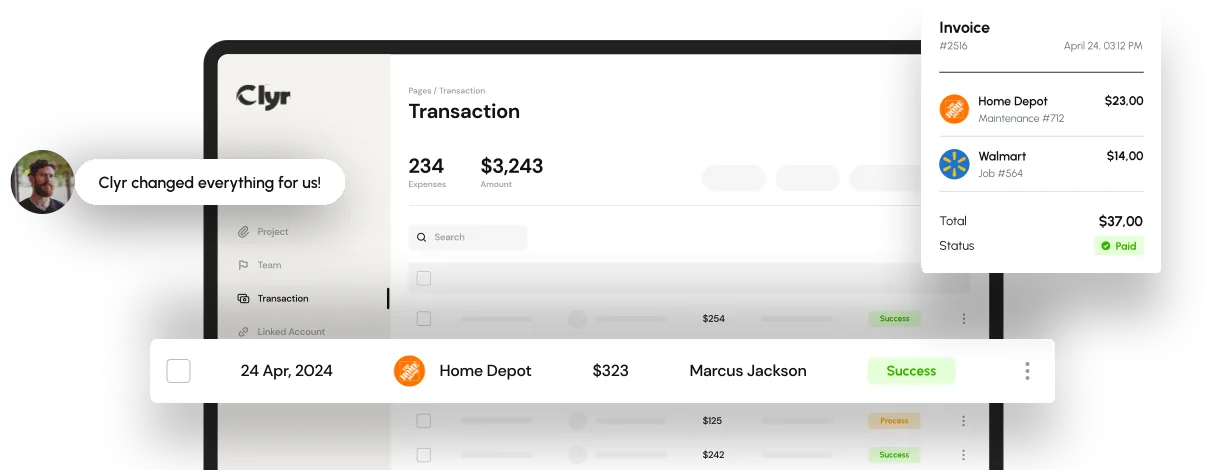
Hours are on timesheets, but materials depend on receipts, and those go missing: parts go on a company card and the receipt stays in the truck. Clyr connects to the cards a business already has and texts the cardholder at the swipe. They reply with a photo of the receipt, and the expense is coded to the job.
Billable expenses and markup lets you flag any expense, or any single line of a split, as billable, and your policy applies the percentage markup automatically. Billable lines flow to the client side of your connected platform, coded and documented, ready for invoicing in your existing billing workflow.
FAQs
It means the line is billed on actual hours and materials, not a quoted price. You'll often see "T&M" beside extra work on a fixed-price job, or "T&M, NTE $5,000" on a service ticket, which means actual time and materials up to $5,000. A ticket that says only "T&M" leaves the price open to argument later.
Not without your approval, if the contract is written well. The usual wording makes the NTE the most you owe unless you sign off on an increase. If a contractor keeps working past the cap without a written approval, the extra may end up as the contractor's loss, depending on the contract and state law.
Only if the contract says so. Some contractors bill from the moment the truck leaves the shop, some charge a flat trip fee instead, and some bill only time on site. Mid-job supply-house runs are the usual sore spot: an hour picking up parts is real labor, but customers push back unless the contract covers it.
It's T&M without the materials. The customer pays fixed hourly rates for labor and buys any parts separately. On federal contracts, FAR 16.602 defines a labor-hour contract as a variation of T&M that differs only in that the contractor doesn't supply materials, and the same limits on use and ceiling prices apply. Private jobs use it too, say when an owner buys the fixtures and hires a crew by the hour to hang them.