
Quick answer: Job costing tracks costs against a single project or job, while process costing tracks costs by production stage across a continuous run of identical units. Contractors, field-service crews, and custom fabricators almost always need job costing, because no two jobs cost the same. Manufacturers running identical units through the same line generally use process costing instead. Pick the wrong one of these costing methods and a losing job can look profitable on paper until the cash runs out.
The confusion usually shows up at month-end, when a project manager asks why a job that felt profitable on-site came in under margin on the books. Nine times out of ten, the cost tracking method is the problem, not the crew.
Key Takeaways
- Job costing: assigns labor, materials, and overhead to a specific project or job number.
- Process costing: averages costs across a production period and divides by units produced.
- Construction, field service, legal, and consulting almost always use job costing.
- Manufacturing, food processing, and other high-volume, uniform output run on process costing.
- Mixing the two, or tracking neither consistently, is the fastest way to misstate job profitability.
- Real-time expense capture tied to a job number keeps job costing accurate without extra data entry.
Job Costing vs Process Costing: The Core Difference
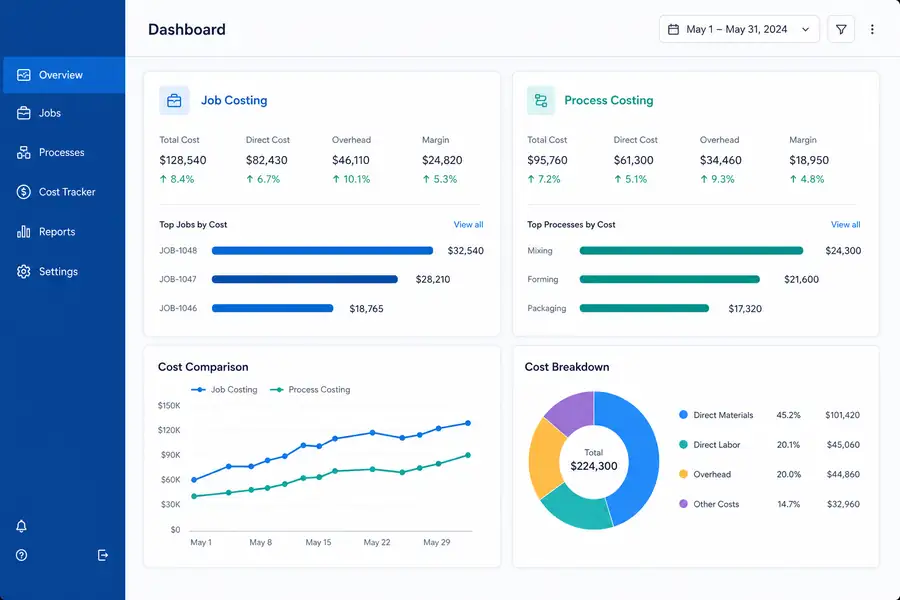
Job costing assigns every dollar of labor, material, and overhead to one specific job; process costing spreads costs across a production run and divides by total units made in a period. That single distinction decides which method fits a business, because it comes down to whether the work is unique or repeatable.
| Attribute | Job Costing | Process Costing |
|---|---|---|
| Unit tracked | Individual job or project | Production stage or department |
| Best for | Custom, non-repetitive work | Continuous, uniform production |
| Typical industries | Construction, field service, legal, consulting | Manufacturing, food processing, chemicals |
| Cost assignment | Direct tracing to the job | Averaging across units in a period |
| Reporting frequency | Per job, on completion or milestone | Per period, weekly or monthly |
| Data source | Timesheets, receipts, POs tagged to a job | Department cost pools and unit counts |
What Is Job Costing?
Job costing is a method that attaches labor, materials, subcontractor bills, and overhead to one specific job or project so you know exactly what that job cost to complete. A general contractor building three houses on three lots needs three separate cost totals, because the framing crew's hours and the lumber invoice belong to one address, not the business as a whole.
This is why expense management for construction businesses almost always centers on job costing. Field crews generate receipts and card charges on-site, and every one of those charges has to land on the right job before it disappears into a general ledger bucket. Miss that step and the job's true cost never gets reconciled. A related risk worth checking against your own numbers is covered in this breakdown of expense types for construction companies, which lays out the categories that most often get miscoded.
Job costing works the same way in field service, property maintenance, legal billing, and consulting: any business that sells distinct units of work, rather than identical units off a line, needs it. Tools built specifically for advanced job costing and profitability tracking remove most of the manual matching that used to eat a bookkeeper's week, tying card swipes and receipts to the right job number automatically. For a deeper look at the mechanics, job costing software built for cost control covers how that tracking works in practice.

What Is Process Costing?
Process costing is a method that totals all costs for a production period, then divides that total by the number of identical units produced to get an average cost per unit. A food processor running 50,000 identical cans through a line in a week does not track cost per can individually. It tracks total material, labor, and overhead for the week and spreads it evenly.
This works because the units are indistinguishable from one another. Chemical plants, textile mills, and beverage bottlers use process costing for the same reason: tracking cost per individual unit would take more effort than the number is worth, and the units do not vary enough for it to matter.
Process costing breaks down the moment work stops being uniform. A custom cabinet shop that also runs a small standardized-parts line often uses process costing for the parts line and job costing for the custom builds, in the same set of books.
Choosing Between Job Costing and Process Costing
Job Costing: Pros, Cons, and Best For
Job costing gives precise, job-level profitability, which is exactly what a project-based business needs to bid accurately and catch scope creep before it erodes margin. The tradeoff is that it demands discipline: every receipt, timesheet entry, and change order has to be tagged to the right job, or the numbers drift.
Best for: construction, field service, property management, event production, legal, and any business that quotes and delivers distinct projects.
Process Costing: Pros, Cons, and Best For
Process costing is fast and low-effort once set up, because there is no per-unit tagging to maintain, just period totals and unit counts. The tradeoff is that it hides variation: if one batch used more material than another, that difference gets averaged away instead of flagged.
Best for: manufacturers and processors running continuous, standardized production with little unit-to-unit variation.
Common Mistakes When Comparing Costing Methods
Most costing errors come from applying one method to a business that actually needs the other, or applying job costing inconsistently across a crew.
- Averaging costs across dissimilar jobs: treating a remodel and a new build as the same type of work hides which one actually made money.
- Letting receipts sit uncoded: a card charge that does not get tagged to a job the same day it happens usually ends up in a general overhead account instead, understating that job's real cost.
- Running job costing on spreadsheets past a handful of crews: manual tagging works for two or three jobs at once; past that, entries get missed or duplicated.
- Ignoring subcontractor and change-order costs: these get billed late and often land in the wrong period or the wrong job if there is no system tying them back to a job number.
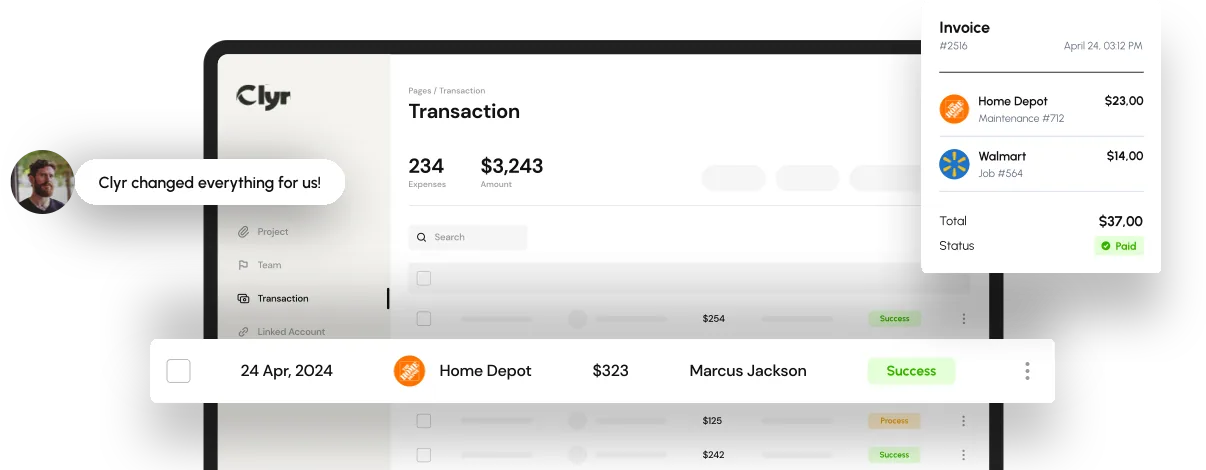
The businesses that keep job costing accurate are the ones that capture the cost the moment it happens, at the point of purchase, rather than reconstructing it from a stack of receipts at month-end. That is the specific gap Clyr closes for field teams: cards and receipt capture tag spend to the right job in real time and sync to QuickBooks, so the job-level numbers are accurate without someone re-keying them later. If manual job costing is slowing down your close, you can book a demo to see how it works for your crews.
FAQs
Can a business use both job costing and process costing?
Yes. Businesses that run both custom and standardized work, such as a fabrication shop that builds one-off orders alongside a repeatable parts line, often use job costing for the custom side and process costing for the standardized side within the same set of books.
Which costing method do construction companies use?
Construction companies use job costing almost universally, because every project has a different site, crew, material list, and timeline. Process costing does not fit construction because no two jobs are identical enough to average their costs together.
Is job costing more expensive to maintain than process costing?
Job costing takes more ongoing effort because every cost has to be tagged to a specific job rather than pooled by period, but that effort is what makes project-level profitability visible. Software that captures and codes receipts and card spend automatically removes most of that manual burden.
What is the biggest sign a business is using the wrong costing method?
The clearest sign is when the books show a healthy margin but the bank account does not match it, or one type of job consistently looks profitable while similar jobs quietly lose money. That usually means costs are being averaged or misassigned instead of tracked at the job level where they actually belong.