What Is a Purchase Order (PO)? Meaning and Example
A purchase order (PO) is a document a buyer sends a vendor to order goods or services, listing the items, quantities, agreed prices, delivery date and payment terms. Once the vendor accepts it, the PO becomes a binding contract, and the buyer later checks the vendor's invoice against it before paying.
When a 12-person electrical contractor needs 40 LED fixtures for a school job, the office sends the supplier PO 1047 for 40 fixtures at $85 each, $3,400 total, delivered to the site by Friday with payment due 30 days after invoicing, and the supplier confirms.
What a purchase order does
A PO does most of its work before any money moves. Someone with authority signs off, and the vendor gets the price, quantity, address and date in writing. A company card works the other way around: the crew lead swipes first, and the charge gets reviewed afterward. If anything over $2,500 needs the owner's sign-off, the PO is where that happens, before the truck is loaded.
It also has legal weight. On its own, a PO is an offer to buy, and it becomes a contract when the vendor accepts it. The Uniform Commercial Code (UCC) is a model law that each US state adopts in its own version, and Louisiana never adopted Article 2, the part that covers sales of goods. Under Article 2, an order for prompt shipment can be accepted by a prompt promise to ship or simply by shipping (UCC 2-206), unless the order clearly calls for another form of acceptance.
So a supplier that loads your order onto its truck has usually accepted your PO without signing anything. Even shipping the wrong item counts as accepting your order, and also as breaking it, so you can still reject goods that don't match (UCC 2-601) if you do it within a reasonable time and tell the seller. The exception is a supplier that promptly says it's only sending a stand-in as a favor: then no contract has formed yet, and you're free to refuse the substitute.
Article 2 covers goods, not services, and your terms can change some of these rights, so for a large order a lawyer can confirm how the rules apply to you.
What goes on a purchase order
Most POs carry the same fields, whether they come from software or a carbon-copy pad:
- A PO number, the buyer's reference for this one order
- The date, the buyer's and vendor's names and addresses, and a contact person
- The ship-to address, such as a job site or property, and the delivery date
- One line per item, with a description or part number, quantity, unit of measure, unit price and line total
- Freight or delivery charges, tax if it applies, and the order total
- Payment terms, such as net 30
- The job, property or cost code the purchase belongs to
- Who approved it, and the terms and conditions or where to find them
Small companies often leave the job or cost code line blank, yet it saves the most time later: the invoice can be coded the day it arrives. Our guide to construction cost codes shows how to build a list.
How the purchase order process works
From request to payment, a PO usually moves through these steps:
- Someone asks for the purchase, often on a purchase requisition, an internal request form.
- A person with authority for that dollar amount approves it.
- The office issues the PO with its own number and sends it to the vendor.
- The vendor accepts, by confirming in writing or by shipping.
- The goods arrive, and whoever receives them checks them against the packing slip, the vendor's list of what's in the shipment, noting anything short or damaged.
- The vendor's invoice arrives, quoting the PO number.
- Accounts payable, the person or team that pays vendor bills, compares the invoice with the PO and the delivery record, then pays on the agreed terms.
- Once everything on the PO is billed and paid, or the rest is canceled, the PO is closed.
The approval limits work like the dollar thresholds in an invoice approval workflow, applied before the purchase instead of after the bill.
A purchase order example with numbers
A roofing company in Ohio is re-roofing a ranch house and sends its supplier PO 2381:
| Item | Quantity | Unit price | Line total |
|---|---|---|---|
| Architectural shingles, bundle | 42 | $38.50 | $1,617.00 |
| Synthetic underlayment, roll | 4 | $96.00 | $384.00 |
| Coil roofing nails, box | 3 | $52.75 | $158.25 |
| Drip edge, 10-foot piece | 10 | $9.80 | $98.00 |
| Delivery to site | 1 | $75.00 | $75.00 |
| PO total | $2,332.25 |
The lines add up: $1,617.00 + $384.00 + $158.25 + $98.00 + $75.00 = $2,332.25. Sales tax is left out for simplicity.
Sending the PO puts nothing in the books, because no shingles have arrived and no bill exists. But the money is spoken for. Say the job's materials budget is $9,000 and $3,100 of bills are already posted. The amount left is $3,567.75 ($9,000 - $3,100 - $2,332.25), not $5,900, because the open PO is a committed cost: money you've agreed to spend but haven't been billed for. If the supplier backorders 4 bundles, the PO stays open for that $154.00 (4 at $38.50) until they arrive or you cancel them.
Many governments and universities track open POs formally, as encumbrances. In the University of Colorado Anschutz guide to purchase order encumbrances, a new PO lowers a budget's available balance without counting as actual spending, and each invoice turns part of the encumbrance into actual expense. A small business gets the same view by listing open POs next to actual costs on its job reports.
When a small business needs purchase orders
Not every purchase needs one. A crew lead grabbing $60 of fittings at the supply house counter should use a company card and send in the receipt.
POs earn their keep on bigger or slower purchases. Pick a dollar line, such as $1,000, and require a PO above it. Add anything ordered now and delivered later, like special-order windows, plus subcontracted work with a set scope and price.
Types of purchase orders
A standard purchase order, the kind most small businesses use, is a one-time order with set items, quantities, prices and dates. A planned purchase order fixes the items and prices but leaves delivery dates tentative. The buyer then sends releases, short orders that schedule each delivery.
A blanket purchase order sets terms with one vendor for a period, often with a spending cap. A property manager might open one with a plumbing supply house for the year, capped at $20,000, so techs can pick up parts without a new PO each time. A contract purchase order sets only general terms, such as payment and delivery terms, without naming any items, and later standard POs refer back to it.
Common purchase order mistakes
An after-the-fact PO defeats the purpose. When the invoice arrives first and someone writes a PO to match it, the paperwork looks clean, but nobody approved the spending in time. If it happens every month, the PO line is probably too low or approvals are too slow.
A price change nobody writes down is another. If the supplier raises shingles from $38.50 to $40.25 after you order, put the new price on a revised PO and approve it like the original, before the invoice arrives.
POs that never close make a job look more committed than it is. Close each one once it's fully billed or the rest is canceled. Watch for split orders, too: two $1,400 POs to one supplier on the same day, when anything over $2,500 needs the owner's sign-off, deserve a look.
Keeping track of purchase orders
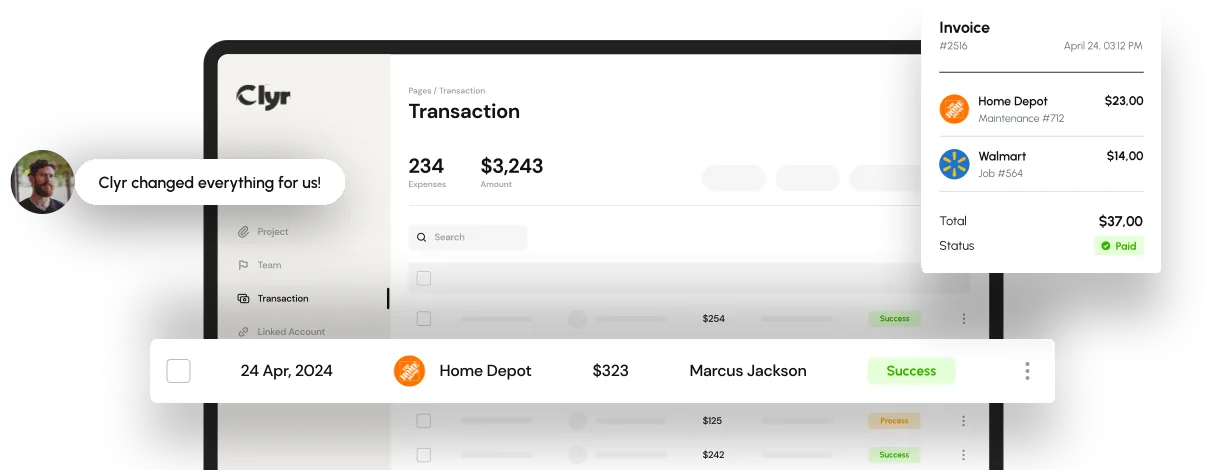
Issuing POs takes nothing more than a numbered log. The harder part comes later, getting each bill onto the job it was bought for. Clyr's bill pay and accounts payable tools include PO matching, flagging discrepancies in pricing or quantities, and every bill lands on the right job and cost code while the crew is still on site. Approvals route by your rules.
FAQs
In business and accounting, PO stands for purchase order. On forms you'll see "PO #," "P.O. No." or "PO number," all meaning the buyer's purchase order number. It has nothing to do with a P.O. box, which is a post office box, even though both can appear on the same vendor setup form.
No. A quote, or estimate, comes from the vendor and says what it would charge. The PO is your answer, ordering at that price. Put the quote number and date on the PO so the quoted price is part of what you ordered, and check that the quote hasn't expired.
Usually, if the vendor hasn't accepted it yet, because until then it's only an offer. One exception for goods: under the UCC, a signed written order from a business that promises to stay open can't be withdrawn for the time it states, or a reasonable time if it names none, up to three months. If that promise is on the vendor's own form, it binds you only if you signed it separately. After acceptance, canceling is a contract question, and special-order goods may carry restocking or cancellation fees.
Yes. Contractors issue POs to subcontractors, and property managers issue them for cleaning or snow removal. A services PO describes the scope, the rate or fixed price, the dates, and often a not-to-exceed amount, a cap the vendor can't bill past without a new approval. Check each invoice against the scope and hours, not just the total.
Usually not. A card purchase is reviewed after the charge, with the statement and receipt as its record. Big-ticket card buys are the exception: some businesses still want a PO before anyone puts $6,000 of equipment on a card, so the approval comes before the swipe. If you pay a PO by card, note that on the PO, because the vendor may still send an invoice, and paying it would pay the order twice.