Reimbursable meaning: what counts as a reimbursable expense
A reimbursable expense is a cost an employee pays out of pocket while doing their job that the employer agrees to pay back, such as mileage, travel, client meals, or supplies bought for a project. It only qualifies as reimbursable if the purchase is business-related, properly documented, and allowed under the company's written expense policy.
A client lunch an employee buys on the road is reimbursable; the same person's dinner at home is not. Job-site supplies put on a personal card are reimbursable; personal tools kept at home are not.
Reimbursable vs non-reimbursable expenses
The reimbursable meaning that matters in practice is simple: a cost is reimbursable when it is for the business, fits the written policy, and has a receipt behind it. Change any one of those and it becomes non-reimbursable. The split usually comes down to whether the spend was for work and whether the policy allows it.
| Usually reimbursable | Usually non-reimbursable |
|---|---|
| Mileage driving between job sites during the workday | The daily commute from home to a regular workplace |
| A client meal while traveling for work | A normal meal eaten at home or at the home office |
| Materials or supplies bought for a specific job | Personal tools or gear kept for personal use |
| The business share of a mixed receipt | The personal portion of that same receipt |
Mixed receipts are the common trap. If an employee buys $60 of job materials and a $12 personal snack on one card, only the $60 is reimbursable, and an itemized receipt is what lets the bookkeeper split the two.
Reimbursable vs billable expenses
Reimbursable and billable are easy to confuse because both move money for a cost someone already paid, but the direction is opposite. A reimbursable expense flows from the company back to the employee who paid out of pocket. A billable expense flows from the company to a client or property owner, often with a markup, and shows up as billable expense income on the books. The same gallon of paint can be both: reimbursed to the tech who bought it, then billed to the owner.
What documentation a reimbursable expense needs
A reimbursement should carry enough proof to survive an audit and code cleanly to the job. In practice that means four things:
- An itemized receipt showing the vendor, the date, the amount, and what was actually bought.
- The business purpose: why the spend was for work.
- The job, property, or account the cost belongs to.
- Who paid and how, so the repayment can be matched and approved.
A card slip that shows only a total is not enough for mixed receipts, hotel bills, or anything your policy flags, because it does not prove what was bought.
How companies pay reimbursements cleanly
A reimbursement that moves without friction follows the same four steps every time: a written policy sets what qualifies, the employee submits the receipt, a manager approves it, and finance pays it back. The slow part is almost always the gap between submitting and approving, where paper receipts and spreadsheets pile up.
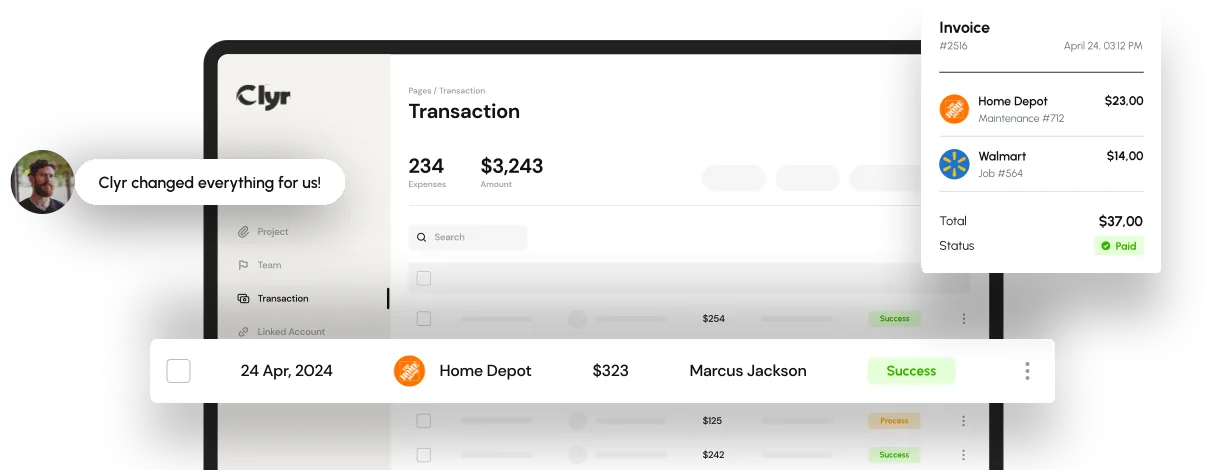
Clyr runs expense management on the cards a company already has, and handles out-of-pocket spend the same way. Employees snap a photo of the receipt, Clyr codes it to the job or property, and it moves through your approval policy before it syncs to your accounting or property-management system with the coding attached. Mileage is logged from a no-login link with no app to install. A personal charge that lands on a company card is flagged so it can be paid back, and business spend an employee fronts on a personal card becomes a reimbursement, with the same receipt capture and coding as card transactions. For the full flow from policy to payment, see the expense reporting process.
FAQ
Usually not. The drive between home and a regular workplace is treated as a personal commute, not a business cost, so most policies do not reimburse it. Miles driven between job sites during the workday, or from the office to a client, generally are reimbursable. Check your written policy, since companies draw this line in different places.
An itemized receipt that shows the vendor, date, amount, and what was bought, plus the business purpose and the job or account it belongs to. A card slip showing only a total is usually not enough, because it does not prove what was purchased. Keeping the itemized version is what lets a bookkeeper code and approve the spend.
No. A per diem is a fixed daily allowance paid instead of reimbursing each receipt, so the employee does not prove what every meal cost. A reimbursable expense pays back an actual cost the employee already incurred and documented. Some companies use per diem for travel meals and lodging and reimburse the rest against receipts.
It depends on where you operate and your policy. Some states require employers to repay necessary business costs, while others leave it to company policy, and federal rules can apply when unreimbursed costs would pull an employee's pay below minimum wage. Treat this as general information and confirm your own obligations with counsel or payroll.
There is no single nationwide deadline. Timing depends on state law and your written policy, which should set a clear window for both submitting and paying a reimbursement. A policy that names a turnaround, such as paying approved reimbursements on the next pay run, prevents most disputes. Confirm any legal timing requirements with counsel or payroll.
It can mean two different things, so it pays to be precise. An employee reimbursement is the company paying a staff member back for an out-of-pocket cost. An owner billback is a cost passed on to the property owner, which is a billable expense, not an employee reimbursement. The repayment direction is what separates them.
Reimburse your team without the paper chase
Clyr codes out-of-pocket spend and mileage to the right job or property and routes it through your approval policy before it syncs to your books. See how on the employee reimbursements and mileage page, or book a demo to walk through your own workflow.