Purchase Order vs Invoice: What's the Difference?
 Expenses
Quick answer: A purchase order is the buyer's formal request to purchase goods or services at an agreed price, issued before any work happens. An invoice is the seller's bill for those goods or services after delivery, requesting payment. The purchase order authorizes the spend; the invoice collects on it.
Confusing the two causes real AP problems: duplicate payments, invoices with no budget behind them, and a close that drags because nothing reconciles. Getting purchase order vs invoice roles straight is the first fix for a messy accounts payable process.
Key Takeaways
- Purpose: a purchase order authorizes a purchase before it happens; an invoice requests payment after delivery.
- Who creates it: the buyer issues the PO, the seller issues the invoice.
- Sequence: in a healthy process, the PO exists before the invoice arrives, not after.
- Matching: AP teams compare the PO, the receiving record, and the invoice (three-way matching) before paying.
- Risk: paying invoices with no matching PO is the single biggest driver of unauthorized or duplicate spend.
Purchase Order vs Invoice at a Glance
The fastest way to see the purchase order vs invoice difference is side by side: a PO looks forward and authorizes spend, an invoice looks backward and requests payment for spend already committed.
| Attribute | Purchase Order | Invoice |
|---|---|---|
| Purpose | Authorizes a purchase before it happens | Requests payment after delivery |
| Created by | Buyer | Seller |
| Sent when | Before goods or services are delivered | After goods or services are delivered |
| Contains | PO number, item list, agreed price, delivery terms | Invoice number, amount due, payment terms, referenced PO number |
| Legal weight | Buyer's commitment to pay if terms are met | Seller's formal demand for payment |
| Used for | Budget control and approval | Accounts payable and payment processing |
What Is a Purchase Order?
A purchase order (PO) is a document the buyer sends a vendor to authorize a specific purchase at a specific price, before any goods ship or work starts. It typically includes a unique PO number, the items or services ordered, quantities, agreed pricing, and delivery dates. Once a vendor accepts it, the PO functions as a contract: the buyer has committed to pay that price if the vendor delivers as specified.
Construction and field service companies rely on POs heavily because job costs need approval before a crew spends money on materials or subcontracted work. A superintendent who orders lumber with no PO on file is spending outside the budget, and nobody finds out until the invoice lands.

What Is an Invoice?
An invoice is the seller's bill, sent after goods or services are delivered, asking the buyer to pay a specific amount by a specific date. Where the PO authorizes spend, the invoice collects on it.
A standard invoice lists an invoice number, the amount due, payment terms (net 30 is common), and, when a PO exists, the PO number it corresponds to. That reference is what lets accounts payable match the bill against an authorized purchase instead of paying on trust.
Property managers see this constantly: dozens of vendor invoices a month for repairs, landscaping, and utilities across different buildings, each needing to tie back to a budget line before payment. This guide to streamlining accounts payable for property managers covers how that reconciliation works at volume.
Purchase Order vs Invoice: The Key Differences That Matter
The real purchase order vs invoice distinction is timing and direction: a PO moves from buyer to seller before the work, an invoice moves from seller to buyer after it. Mixing that order up is what causes most AP disputes.
A PO is a promise to pay if the vendor delivers as agreed. An invoice is the demand for that payment once delivery happens. A PO with no invoice is an open commitment sitting on the books; an invoice with no PO is a bill nobody approved.
How Purchase Orders and Invoices Work Together
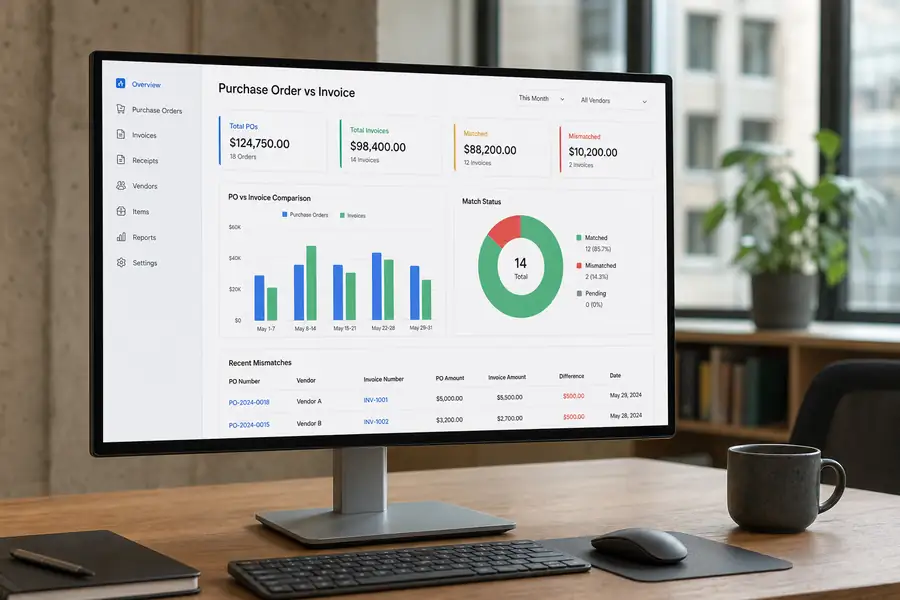
Purchase orders and invoices connect through matching, the process of confirming a vendor's bill lines up with what was authorized and what actually arrived. Most AP teams use three-way matching: comparing the purchase order, the receiving record, and the invoice before releasing payment.
This guide to mastering three-way matching covers the mechanics, but the short version is that any mismatch (wrong price, wrong quantity, a vendor name that doesn't match vendor records) flags the invoice for review instead of paying automatically.
Doing this by hand means someone re-keys PO numbers, chases receiving confirmations, and cross-checks vendor records in a spreadsheet. Automated bill pay and accounts payable tools run that match automatically and route only the exceptions for approval. For field teams, that matters even more when spend happens on-site: a crew captures a receipt on a card in the field, it codes to the job automatically, and it syncs to QuickBooks already tagged for matching. Clean vendor records make that matching reliable too, which is where a dedicated vendor management system earns its place in the stack.
Common Mistakes with PO vs Invoice Management
The most common PO vs invoice mistake is paying an invoice that never had a purchase order behind it. That means someone authorized spend after the fact, which defeats the point of budget control.
- Skipping the PO for "small" purchases: unauthorized spend adds up fast when there is no floor for when a PO is required.
- Invoices with no PO reference: AP has nothing to match against, so approval slows or skips a step entirely.
- Manual matching: comparing PO, receipt, and invoice by hand invites transposition errors and duplicate payments.
- Inconsistent vendor names: a vendor billed under two slightly different names breaks automated matching and hides duplicate invoices.
Fixing this is less about a new rule and more about the right tooling. This handbook for selecting AP software walks through what actually matters when evaluating options, beyond a feature checklist.
If your team is still matching purchase orders to invoices by hand, it's worth seeing what that looks like automated. Book a demo to see how Clyr handles PO matching, receipt capture, and bill pay together.
FAQs
What comes first, a purchase order or an invoice?
The purchase order comes first. It authorizes the purchase before any work begins, and the invoice follows after delivery to request payment for that already-approved spend.
Can a vendor send an invoice without a purchase order?
Yes, especially with smaller vendors or recurring bills like utilities. Accounts payable then has to verify the charge manually instead of matching it against an existing authorization, which takes longer and carries more risk of paying for something nobody approved.
Is a purchase order legally binding?
Once a vendor accepts its terms, a purchase order functions as a contract: the buyer has committed to pay the stated price if the vendor delivers as specified. An invoice is a payment demand, not an agreement both sides signed off on in advance.
What is three-way matching in accounts payable?
Three-way matching checks a vendor invoice against its purchase order and receiving record before payment goes out, confirming the price, quantity, and vendor all line up. It's the standard control AP teams use to catch billing errors and prevent duplicate or unauthorized payments.
Do small businesses need purchase orders?
Small businesses benefit from purchase orders as soon as more than one person can commit to spend. Even a simple PO process gives owners a paper trail and a budget check before money goes out, instead of finding out about a purchase when the invoice arrives.