
Most corporate travel policy templates are built for a company that doesn't exist. They cap hotel rates in cities you never visit, skip your actual approval chain, and say nothing about how a field crew submits receipts from a job site. The faster fix is writing the policy yourself, with AI handling the drafting while you supply the real rules your company runs on. This walks through the exact prompts and review steps to get a usable corporate travel policy finished in an afternoon, instead of stretching a generic travel policy template to fit a company it was never written for.
- AI can draft a full corporate travel policy in minutes, but only after you feed it your real company inputs.
- A three-prompt sequence (draft, stress-test, enforce) catches most of the gaps a downloaded travel policy template misses.
- Legal and HR still have to review and sign off before anything goes to employees.
- Export the draft as a CSV table for spreadsheets, or paste it into Google Docs for the policy document itself.
- Field and site-based teams need the policy tied to how cards and receipts actually get coded, not just a PDF nobody rereads.
Gather Your Inputs Before You Draft a Corporate Travel Policy
An AI model writes a better first draft when you tell it exactly how your company operates, rather than asking it to invent a generic corporate travel policy. Before you open ChatGPT or Claude, write down six things.
- Company size and structure: headcount, number of offices, and whether travel is mostly office staff, sales, or field crews.
- Budget posture: conservative (tightest caps, coach class, standard hotels) or moderate (more flexibility on class and hotel tier).
- Booking rules: which tool or agency employees use and how many days in advance a trip must be booked.
- Per diem and meal limits: your target daily rate, checked against the current GSA per diem rates for the cities your team visits.
- Approval flow: who approves the trip request, who approves the expense report, and the dollar threshold that triggers escalation.
- Non-reimbursable items: what already gets rejected on expense reports today, and why.
These six inputs are also the backbone of solid corporate travel management, so it helps to see how other companies structure them before you lock in your own version.
Draft Your Corporate Travel Policy with This AI Prompt
Once you have your six inputs, paste them into the first prompt. It produces a full first draft in one response, organized into the sections a corporate travel policy actually needs.
Prompt 1 (draft the policy):
"Act as an HR and finance policy expert. Draft a corporate travel policy for a [size]-person US company with a [conservative/moderate] budget. Sections: purpose & scope, booking procedures (advance-booking windows), flight class rules by duration, hotel caps by city tier, ground transport, meals & per diem (reference current GSA rates), expense reporting deadlines, non-reimbursable items, approval workflow, duty of care & emergencies, policy violations. Use clear, employee-friendly language."
Swap the bracketed details for your real numbers before you run it. The output will read like a competent HR draft, not a finished policy. Treat it as version 0.1.
Review the Draft Corporate Travel Policy Section by Section
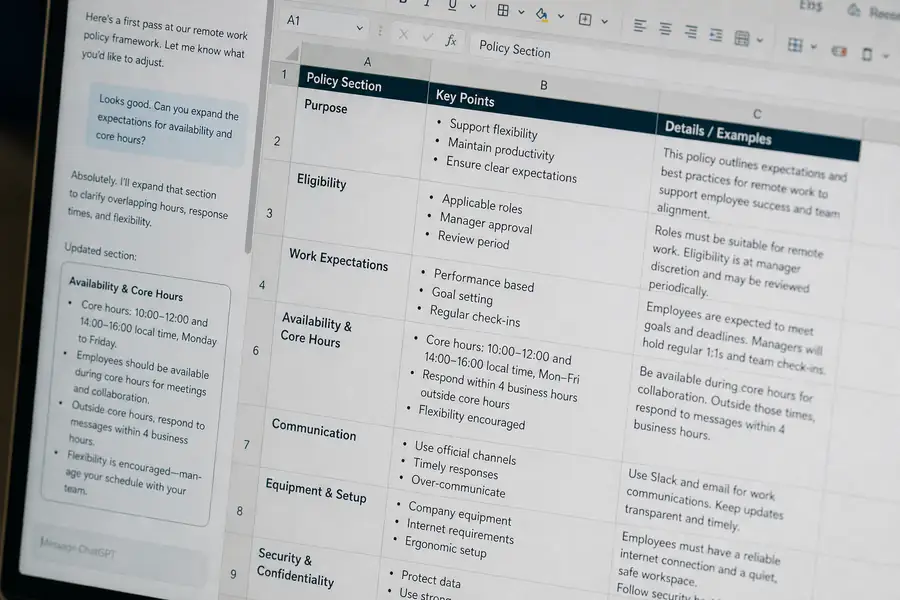
Read the draft the way an employee will: section by section, looking for anything vague enough to cause an argument later. Check the flight class rules against how long your actual routes run. Check hotel caps against real nightly rates in the cities your team visits most, not a national average.
Pay closest attention to the expense reporting and per diem sections, since that is where most disputes happen. If the reimbursement language or receipt deadlines feel thin, our travel reimbursement policy guide covers the details AI tends to gloss over, like what happens when a receipt is lost or a trip spans a weekend.
Stress-Test Your Corporate Travel Policy for Edge Cases
A first draft rarely covers the situations that actually generate approval headaches: a weekend add-on, a spouse tagging along, a canceled flight, loyalty points earned on a company card. Run the second prompt to force the AI to find its own blind spots.
Prompt 2 (stress-test it):
"Review the policy you just wrote as a skeptical employee: list 10 ambiguous situations it doesn't cover (weekend stays, loyalty points, bleisure days, cancellations, companion travel) and rewrite the relevant sections to close each gap."
Read the ten gaps it surfaces and decide which are real risks for your company. Not every edge case needs a rule. A clause for something that happens once a year just adds a page nobody reads.
Make Your Travel Policy Template Enforceable
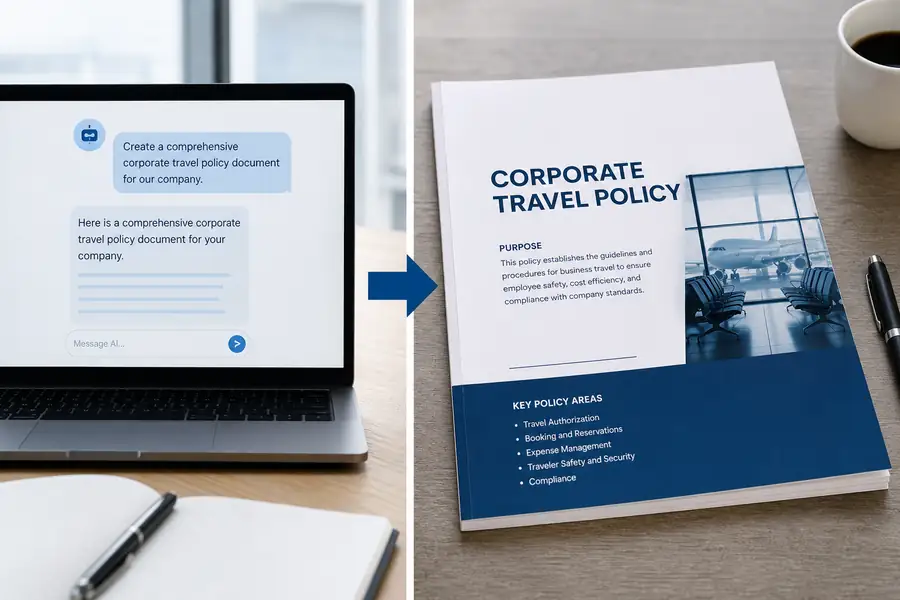
A policy nobody can act on in the moment doesn't get followed. Turn the stress-tested draft into tools people will actually use.
Prompt 3 (make it enforceable):
"Convert the final policy into: a 1-page quick-reference summary for employees, and a checklist version an approver can use when reviewing each trip expense report."
The one-page summary goes to employees before their first trip. The checklist goes to whoever signs off on expense reports, so approvals stop depending on one manager's memory of what the policy says.
Get Legal and HR Sign-off, Then Publish
AI-drafted language still needs a human check before it becomes company policy. Send the near-final version to HR for tone and fairness, and to legal or your accountant for anything touching tax treatment, mileage, or per diem, since those figures shift and a stale number in a published policy is a compliance problem waiting to surface.
Once sign-off is done, publish it somewhere permanent, like the employee handbook or an intranet page, and walk new hires through it during onboarding instead of emailing a PDF and hoping it gets read.
Iterate and Export: Turning the Draft into a Spreadsheet or Doc
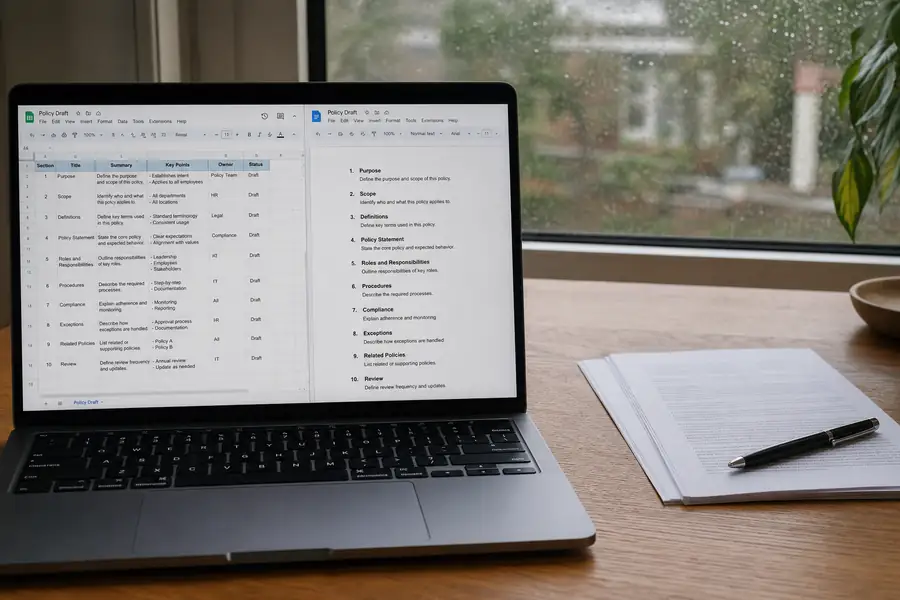
The same AI thread keeps improving the policy long after the first draft. Ask it to add a column for international travel, adjust hotel caps for a new city tier, or rewrite a section for a 200-person company instead of a 20-person one, and it revises in place instead of starting over.
For anything table-based, like hotel caps by city tier or per diem by role, ask the AI to output a CSV code block you can import straight into Excel or Google Sheets. For the policy document itself, paste the finished markdown into Google Docs or Word so legal and finance can comment and redline in the tool they already use.
When a Business Travel Policy Template Isn't Enough
A written policy sets the rules. It doesn't enforce them at the point someone swipes a card in an airport or on a job site, and that gap is where most violations actually happen, not from bad intent but from nobody checking the rule in the moment.
Expense management software closes that gap by applying your caps and approval flow automatically as spend happens, instead of catching violations weeks later at expense report time. Clyr, for example, captures receipts and codes card spend in real time and syncs with QuickBooks so nothing gets re-entered by hand, which matters most for field and construction teams booking travel from a job site rather than a desk.
If you want to see how that fits alongside the policy you just built, you can book a demo and walk through it with the team.
FAQs
Can AI write a legally compliant corporate travel policy on its own?
No. AI can produce a strong first draft and catch gaps a human might miss, but tax treatment, mileage rules, and per diem figures need a legal or accounting review before the policy is published. Treat the AI output as a draft that still needs sign-off, not a finished legal document.
What should a corporate travel policy include?
A complete policy covers purpose and scope, booking procedures, flight and hotel rules, ground transport, meals and per diem, expense reporting deadlines, non-reimbursable items, an approval workflow, duty of care during emergencies, and consequences for violations. Most gaps show up in the edge cases, like weekend stays or canceled flights, rather than in the main sections.
How often should a business travel policy be updated?
Most companies review a travel policy once a year, or sooner if per diem rates change, headcount grows past a threshold that changes approval needs, or a specific edge case keeps causing disputes. Because you built the policy with an AI thread, updating it is a matter of asking for the specific change rather than rewriting the document.
Do small companies need a formal travel policy?
Yes, even a ten-person company benefits from a written policy, because it removes the guesswork that causes disputes over hotel tiers or meal limits. A short one-page version is often enough at that size, and it can grow into a longer document as headcount and trip volume increase.