Receipt Retention Rules: How Long to Keep Receipts
 Expenses
Quick answer: Keep most receipts for three years from the date you file the related tax return, since that is the standard IRS audit window. Hold onto records for equipment purchases, vehicle mileage, and property improvements for as long as you own the asset, plus three more years, and keep anything tied to underreported income or an unfiled return indefinitely.
Receipt retention requirements are the length of time a business needs to keep receipts, invoices, and other proof-of-purchase records to satisfy tax law, survive an audit, and back up its own expense policy. For field teams, that means matching every receipt to a category and a retention clock, not stuffing it in a glove box until tax season arrives. How long to keep receipts depends entirely on what the receipt is proving, which is exactly what the sections below break down.
How Long to Keep Receipts by Document Type
Most routine expense receipts only need to survive three years, but a handful of document types carry longer receipt retention requirements because they support deductions the IRS can revisit further back. The table below covers the categories field teams and office staff run into most often.
| Document Type | Keep For | Why It Matters |
|---|---|---|
| Routine expenses (fuel, meals, supplies) | 3 years | Standard IRS audit window |
| Mileage and per diem logs | 3 years after filing | Supports the deduction if questioned |
| Equipment and vehicle purchases | Life of asset, plus 3 years | Needed to calculate depreciation and gain or loss on sale |
| Property and capital improvements | As long as you own the property, plus 3 years | Establishes cost basis |
| Payroll and employment tax records | 4 years | Required under federal employment tax rules |
| Unfiled returns or suspected underreporting | Indefinitely | No time limit on IRS assessment |
If you want the day-to-day system for sorting and storing these as they come in, rather than just the retention clock, this guide on how to keep track of receipts walks through the habits that keep a shoebox from forming in the first place.
Receipt Retention Requirements for IRS Audits
The IRS generally has three years from your filing date to audit a return, which is why three years is the baseline for most receipt retention requirements. That window stretches to six years if you underreported gross income by more than 25%, and seven years if you are claiming a loss from worthless securities or a bad debt deduction.
There is no time limit at all if you never filed a return, or if the IRS can show the return was fraudulent. In either case, keep every supporting record indefinitely. These exceptions matter most for businesses carrying a loss forward or still depreciating an asset purchased years earlier, so it is worth checking the exact rule against your own filing history rather than assuming the standard three-year window applies.
What Field Teams Should Keep and for How Long
Field teams generate more receipts per week than most office staff, and more of those receipts need to tie back to a specific job, not just a general ledger line. A construction crew running three active sites needs fuel, tool, and material receipts coded to the right job the same day, because reconstructing which site a $40 hardware store run belonged to six months later is nearly impossible. Teams managing this volume often lean on dedicated expense management for construction rather than general-purpose apps, since job costing is baked into the workflow instead of bolted on.
Field service technicians have a lighter version of the same problem: parts receipts, mileage between calls, and the occasional customer reimbursement all need to survive the standard three-year window and stay attached to the right work order. Property managers face a related but distinct version, since a single repair receipt might need to be split across two units or billed back to an owner, so the retention clock and the cost allocation have to travel together.
Digital Receipt Retention Requirements
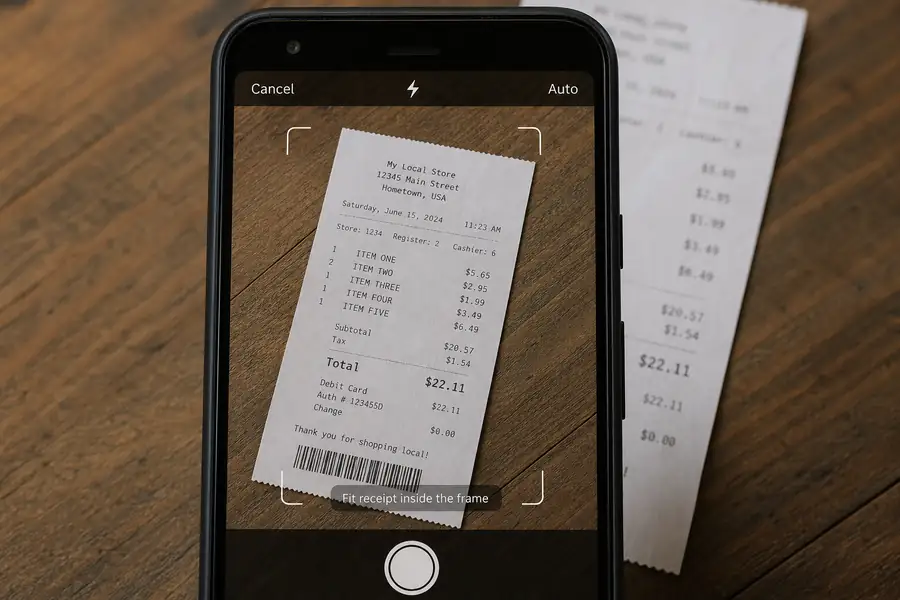
Digital receipts satisfy IRS retention requirements as long as the image is a complete, legible copy of the original and you can produce it on request. That means a photo of a gas station receipt counts the same as the paper slip, provided the date, vendor, and amount are readable and the file is actually retrievable years later, not buried on a phone that got replaced.
This is the part manual processes get wrong most often. A paper receipt fades in a truck console, a photo gets saved to a personal camera roll and never makes it to the books, and by the time an audit letter arrives, nobody can find the original. Clyr's real-time receipt capture and coding solves this by logging each receipt the moment a card is swiped or a crew member snaps a photo, timestamped and coded before it has a chance to disappear. Paired with a QuickBooks integration, those records sync straight into the books instead of sitting in a folder waiting to be entered by hand.
Common Mistakes with Receipt Retention
- Tossing receipts after reimbursement: the expense report is paid, but the IRS clock has not started yet.
- Saving only the total, not the itemized receipt: a card statement shows the charge but not what was purchased, which weakens an audit defense.
- Storing photos on a personal phone: records disappear the moment the device is lost, replaced, or wiped.
- Treating every receipt the same: a $12 lunch and a $4,000 piece of equipment carry very different retention requirements.
- Waiting for tax season to organize anything: reconstructing a year of job-coded receipts in April is slower and less accurate than logging them as they happen.
Receipt retention requirements do not have to mean a drawer full of faded paper and a scramble every April. See receipt capture in action with a quick Clyr demo and keep every record organized and ready well before the IRS ever asks.
FAQs
How long should I keep receipts for taxes?
Keep most tax-related receipts for three years from the date you filed the return they support, since that matches the standard IRS audit window. If you underreported income by more than 25%, keep those records for six years, and if you never filed a return at all, keep everything indefinitely.
Can I keep digital copies instead of paper receipts?
Yes. The IRS accepts scanned or photographed receipts as long as the image is a clear, complete copy of the original and you can produce it if asked. The underlying expense still needs to be legible: vendor name, date, and amount all need to be readable in the saved file.
What happens if I throw away a receipt I need for taxes?
Without a receipt, you may still claim a deduction if you can reconstruct the expense another way, such as a bank statement or calendar entry, but the IRS can disallow the claim if it doubts the amount or purpose. Rebuilding records after the fact almost always costs more time than keeping a digital backup from the start.
How long do field crews need to keep mileage and fuel receipts?
Field crews should keep mileage logs and fuel receipts for three years after filing the tax return that includes the related deduction. If a vehicle is being depreciated, keep those records for as long as the business owns the vehicle, plus three more years after it is sold or retired.
Can the IRS audit me after three years?
Usually not, but there are exceptions. The IRS can go back six years if you underreported gross income by more than 25%, and there is no time limit at all for a fraudulent return or one that was never filed.