
Quick answer: The IRS generally does not require a receipt for an individual business expense under $75. Above that amount, you need documentary evidence, meaning a receipt, invoice, or itemized statement showing the amount, date, place, and business purpose. The one exception field teams miss: lodging expenses always need a receipt, no matter how small the bill.
That $75 threshold comes from IRS recordkeeping rules for travel, entertainment, and business expenses, and it has not changed since the mid-1990s. It is not an excuse to skip documentation altogether. It just changes what counts as acceptable proof, and for crews submitting business expenses from job sites, that distinction is exactly where most reimbursement disputes start.
What Are the IRS Receipt Requirements for Business Expenses?
IRS receipt requirements come down to one core rule: any expense of $75 or more needs documentary evidence, and any lodging expense needs it regardless of cost. Documentary evidence means a receipt, paid invoice, or itemized statement that shows the amount, date, place, and business purpose of the expense. A canceled check or card statement line alone does not satisfy this on its own; it has to be paired with something that shows what was actually purchased. This standard comes from IRS Publication 463, which governs travel, gift, and car expenses for employees and the self-employed.
The rule exists so a deduction can be verified as real business spending, not a personal charge run through a company card. For crews buying fuel, materials, or meals on the road, the paperwork burden scales with the dollar amount, not the category of purchase.
When Is a Receipt Not Required Under $75?
A receipt is not legally required for most individual business expenses under $75, but a record of the spend still is. A $12 parking fee, an $8 toll, or a $40 hardware store run for a job site does not need a physical receipt under IRS rules. Your own records still need to capture the amount, date, place, and business purpose, the same four facts a receipt would show.
That is where teams get sloppy. Skipping the receipt is fine under the threshold. Skipping the record entirely is not, because an expense with no documentation of any kind is much harder to defend if it is ever questioned. Our guide on how to keep track of receipts covers simple habits for logging these smaller purchases so nothing falls through the cracks.
| Expense type | Receipt required? | What you still need |
|---|---|---|
| Fuel, tolls, parking under $75 | No | Amount, date, location, purpose noted |
| Tools or materials under $75 | No | Vendor, amount, job or project tied to it |
| Any expense of $75 or more | Yes | Itemized receipt or invoice |
| Lodging, any amount | Yes | Itemized hotel receipt |
What Counts as an Itemized Receipt Under IRS Rules?
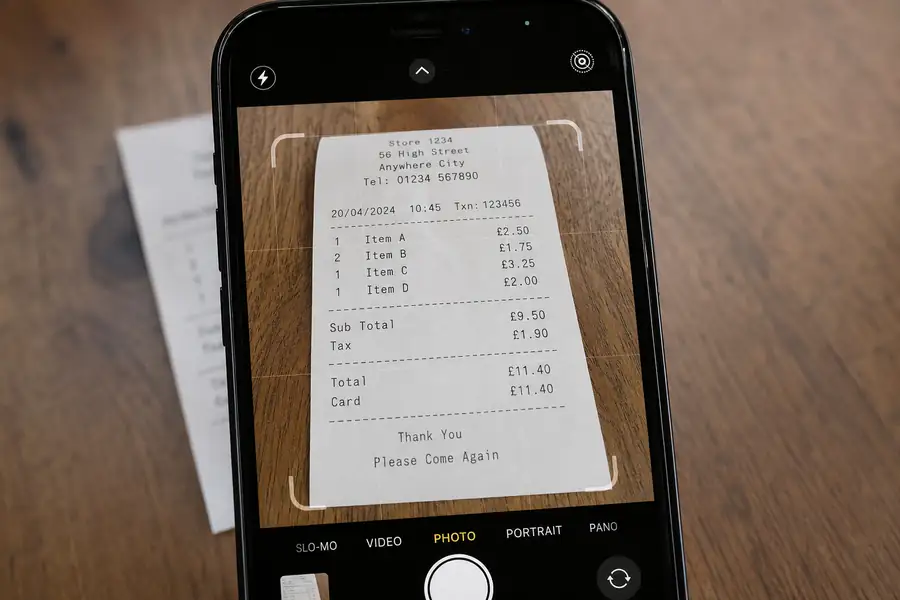
An itemized receipt lists each individual item or service purchased, not just a total charge, and the IRS expects this level of detail on any expense at or above the $75 threshold. A card slip that shows only a merchant name and a total dollar amount does not qualify, because it does not prove what was bought or whether it was a legitimate business cost. Our breakdown of what is an itemized receipt walks through exactly what has to appear on the document.
This trips up field crews constantly. A gas station receipt that only shows a pump total is fine under $75, but a $180 tool purchase with the same generic total is not going to hold up. The fix is asking for the itemized version at checkout, every time, once the purchase crosses that line.
How Field Teams Can Meet IRS Receipt Requirements Without the Paper Chase
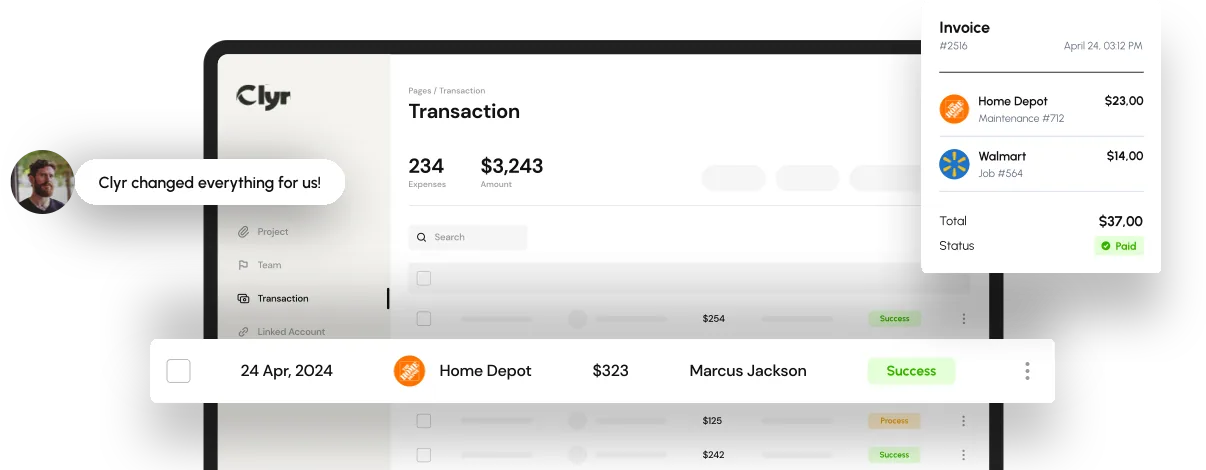
Field teams meet IRS receipt requirements most reliably when receipt capture happens at the moment of purchase, not at the end of the week. A crew member photographing a receipt on their phone right after paying captures the date, amount, and vendor before the paper gets lost in a truck cab or a tool bag. Clyr's real-time receipt capture and coding matches each card swipe to a photographed receipt as it happens, then codes it to the right job or property automatically.
For construction crews, that means a $220 materials run gets tied to the correct job before the invoice ever reaches the office. For property management teams juggling repairs across a dozen units, the same automatic coding keeps spend split correctly by property instead of dumped into one general account. Once coded, the data syncs to QuickBooks so nobody re-keys the transaction at month-end close.
Common Mistakes with IRS Receipt Requirements
- Assuming under $75 means no record at all: the dollar amount still needs to be logged somewhere, even without a physical receipt.
- Treating a card statement as proof: a statement line shows a charge happened, not what was purchased or why.
- Skipping itemization on lodging: hotel bills need a receipt every time, regardless of the total.
- Letting paper receipts pile up: faded thermal paper is unreadable within weeks, which defeats the purpose of keeping it.
- Waiting until month-end to submit expenses: details like business purpose get fuzzy fast once a week has passed.
FAQs
Do I need a receipt for every business expense?
No. The IRS generally only requires documentary evidence for individual expenses of $75 or more, plus all lodging expenses regardless of amount. Below that threshold, you still need to record the amount, date, place, and business purpose, just not a physical receipt.
What happens if I lose a receipt for an expense over $75?
You can reconstruct the expense with other evidence, such as a calendar entry, a card statement, and a written explanation of the amount, date, place, and business purpose. This is harder to defend than an original receipt, so it should be the exception, not the plan.
Does a credit card statement count as a receipt for the IRS?
No. A statement shows that a charge occurred, but it does not show what was purchased, which the IRS requires for documentary evidence on expenses of $75 or more. You need an itemized receipt or invoice alongside the statement.
Are meal and lodging receipts treated differently under IRS rules?
Lodging is treated differently: it always requires a receipt, no matter how small the bill. Meals generally follow the standard $75 threshold like other expenses, unless your company's own expense policy sets a lower bar.
See how real-time receipt capture keeps every expense documented automatically, from the job site to the books. Book a demo to see it in action.