
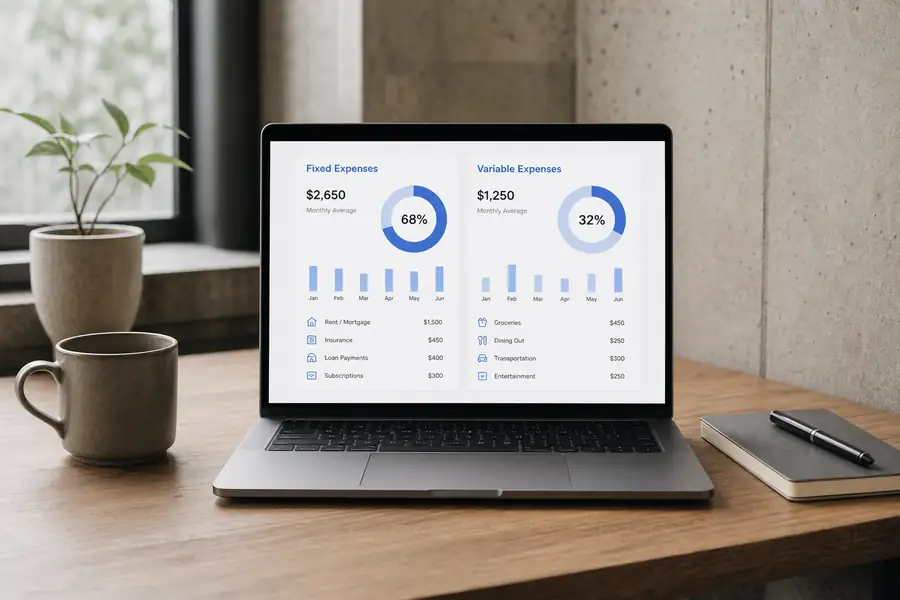
Fixed expenses stay at roughly the same dollar amount every billing period, no matter how much you sell or produce: rent, salaried payroll, insurance premiums, and loan payments are classic examples. Variable expenses move with activity level instead, so materials, hourly labor, sales commissions, and fuel all rise and fall with volume. Getting fixed and variable costs classified correctly decides whether your budget holds up when revenue swings, and mixing the two up is one of the most common errors bookkeepers untangle during month-end close.
Key Takeaways
- Fixed costs: the same amount each period regardless of output, like rent, insurance, and salaries.
- Variable costs: rise and fall with sales volume or activity, like materials, commissions, and fuel.
- Semi-variable costs: a fixed base charge plus a variable, usage-based piece, like a utility bill or overtime pay.
- Classification accuracy drives your break-even math, your job costing, and your cash flow forecast.
- The most common mistake is filing a semi-variable cost as purely fixed, which understates real budget swings.
Fixed vs Variable Expenses: Side-by-Side Comparison
The fastest way to tell a fixed expense from a variable expense is to ask whether the total changes when sales or production volume changes. The table below is the version bookkeepers check first when a cost lands in an unfamiliar bucket.
| Attribute | Fixed Expenses | Variable Expenses |
|---|---|---|
| Changes with sales volume | No | Yes |
| Typical examples | Rent, salaries, insurance, software subscriptions | Materials, hourly labor, commissions, fuel |
| Budgeting approach | Set once per period, easy to forecast | Estimated per unit, forecast from volume |
| Risk when revenue drops | Cost stays flat, margin shrinks fast | Cost drops with revenue, margin holds steadier |
| Risk when volume spikes | Cost stays flat, margin improves | Cost climbs with volume, gain is limited |
| Who tracks it closely | Finance leads building overhead budgets | Bookkeepers doing job costing and margin checks |
What Counts as a Fixed Cost?
A fixed cost is a bill your business pays at roughly the same dollar amount every cycle, independent of how many units you sell or hours you bill. Rent and mortgage payments, salaried payroll, business insurance premiums, and software subscriptions like your accounting platform all sit in this bucket. A landscaping company pays the same equipment lease in a slow January as it does in a busy June. Both fixed and variable costs affect what you can write off at tax time; for a full rundown of which category common costs fall into, see this business expenses list.
Pros and cons of fixed costs
- Predictable budgeting: the same figure lands on the books every month, so forecasting overhead is straightforward.
- Margin upside at volume: once fixed costs are covered, each additional sale contributes more directly to profit.
- Downside risk: fixed costs do not shrink when revenue drops, so a slow quarter can turn a fixed-cost-heavy business unprofitable fast.
Fixed costs work best for businesses with stable revenue: subscription companies, property managers with steady occupancy, and firms running long-term contracts can plan around them with confidence.
What Counts as a Variable Cost?
A variable cost rises and falls with production or sales activity, so the total changes every period even when the rate per unit stays flat. Raw materials, hourly wages, sales commissions, fuel, and shipping are the standard examples. A construction company's material spend on a job site swings with the square footage poured that month, unlike its office rent.
Pros and cons of variable costs
- Scales with revenue: costs drop automatically when sales slow, which protects margin during a downturn.
- Harder to forecast: the total depends on volume, so budgeting needs a per-unit estimate rather than a flat number.
- Job costing exposure: if variable spend isn't coded to the right job or client, project profitability numbers drift.
Variable costs are the norm in construction, field service, and event production, where spend tracks job by job rather than a flat monthly line.
Common Mistakes When Classifying Fixed and Variable Expenses
The most common classification error is treating a semi-variable cost as purely fixed. A semi-variable cost carries a flat base charge plus a usage-based component, the way a utility bill has a minimum monthly fee plus metered usage, or an hourly employee earns base pay plus overtime once they cross 40 hours. Bookkeepers who file these as flat fixed costs understate the real swing in the budget.
- Filing overtime as fixed labor: base salary is fixed, but overtime and per diem pay flex with the job and belong in the variable column.
- Coding job-site materials to overhead: materials belong to the job that used them, not a general supplies line, or job costing breaks down.
- Ignoring step-fixed costs: some costs, like adding a second delivery van, stay flat until volume crosses a threshold, then jump. Budget for the jump, not a smooth line.
- Letting personal charges slip onto a company card: this muddies both categories if it isn't caught at the receipt stage rather than at reconciliation.
How to Track Fixed and Variable Expenses Without the Guesswork
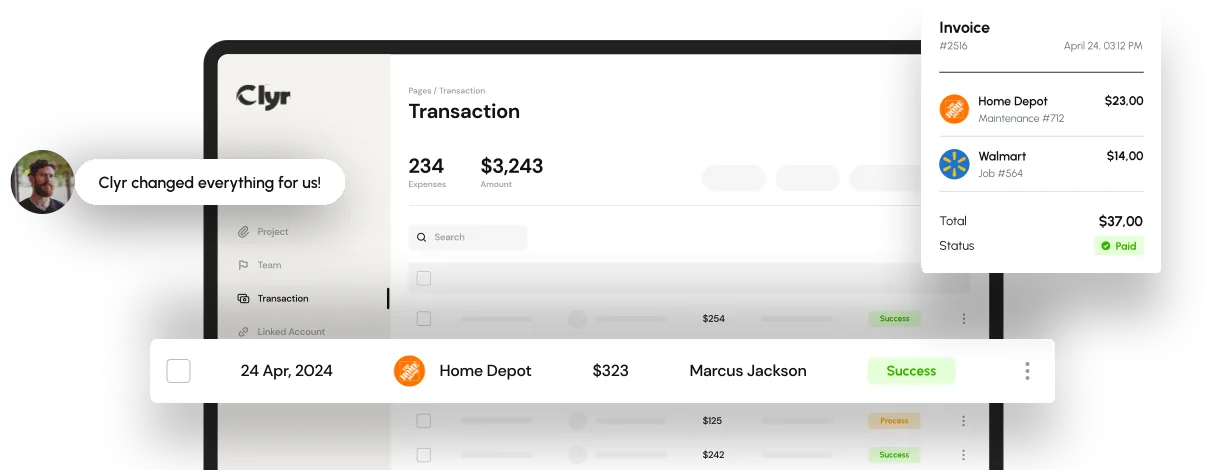
The fastest fix for classification confusion is capturing the cost detail at the moment of spend, not reconstructing it at month-end. When a field crew's fuel or materials receipt is coded to the job and cost category in real time, the variable side of your budget stays accurate without a bookkeeper chasing down a paper trail weeks later. Good expense management software is what makes that possible for both cost types at once.
Clyr pairs card spend with real-time receipt capture and coding, so variable field spend and fixed recurring charges land in the correct bucket the moment they happen, then sync to QuickBooks for the close. If you want to see how that workflow looks for your own chart of accounts, you can book a demo with Clyr's team.
FAQs
What is the difference between fixed and variable expenses?
Fixed expenses stay at the same dollar amount each billing period regardless of sales or production, like rent and salaries. Variable expenses change in total based on activity level, like materials, hourly labor, and fuel, even though the per-unit rate often stays the same.
Is payroll a fixed or variable expense?
It depends on the pay structure. Salaried payroll is fixed because it doesn't change with hours worked or output, while hourly wages, overtime, and commissions are variable because the total shifts with hours or sales volume.
What is a semi-variable cost?
A semi-variable cost combines a fixed base charge with a variable, usage-based component. A utility bill with a minimum monthly fee plus metered charges, or a phone plan with a base rate plus overage fees, are both common examples.
How do fixed and variable expenses affect break-even analysis?
Break-even analysis divides total fixed costs by the difference between your price per unit and your variable cost per unit. A business with higher fixed costs needs more volume to break even, while one with higher variable costs breaks even sooner but keeps thinner margins per sale.
Can a fixed cost become variable over time?
Yes. Costs can shift categories as a business changes how it buys or scales. A company that moves from a flat software subscription to a per-user or usage-based plan effectively turns a fixed cost into a variable one, and step-fixed costs like adding equipment can jump to a new fixed level once volume crosses a threshold.