What Is an Audit Trail in Accounting?
An audit trail is the chain of records that lets anyone trace a number in your books back to the document behind it, and see who entered, approved or changed it, when, and what it said before. For a business, that means receipts, invoices, approvals and change history tied to each transaction.
With a good audit trail, a $1,240 materials charge in your books for a kitchen remodel leads you to the supply-house receipt, shows the crew lead sent it in on March 4, and shows the bookkeeper moved it off the wrong job two days later.
What an audit trail means in accounting
Every number in your reports is a total of smaller entries, and each entry should rest on a source document: a receipt, an invoice, a bank statement. The audit trail is the path between them, and you should be able to walk it both ways.
Auditors have a name for each direction. Vouching starts with an entry in the general ledger, the master record of every account in your books, and works back to the receipt to prove the transaction happened. Tracing starts with the documents and works forward to prove each one was recorded.
A complete trail has two layers: the documents, and a change history showing who created, approved or edited each entry and when. Paper gives you only the first, so a slip with $480 crossed out and $840 written in shows that something changed, but not who changed it or when. Accounting software adds the second layer, as long as everyone signs in as themselves.
What each record in the trail should show
Here is one line from a change history after a bookkeeper fixed a miscoded card charge:
| The record shows | Example |
|---|---|
| Who | The bookkeeper, under her own user name |
| What | Changed the job on a card charge |
| When | March 6, 2026, at 9:14 a.m. |
| Before | Job 2207, bathroom remodel |
| After | Job 2214, kitchen remodel |
| Why | Crew lead confirmed the tile was for the kitchen |
Many logs leave out the before and after values. A log line that says "record edited" tells you someone touched the entry, not what changed. If an amount went from $1,240 to $1,420, both numbers belong on the record.
The source document needs its own facts too. The IRS says supporting documents for expenses should identify the payee, the amount paid, proof of payment, the date incurred and a description showing it was a business expense, and that you may need a combination of documents to cover all of that.
Corrections should add to the trail, not erase it. A posted entry is normally fixed with a reversing or adjusting entry, a new entry that cancels or corrects the old one, so the mistake and the fix both stay visible. Deleting a transaction and keying it in again leaves a hole.
Audit trails for receipts and expenses
For a company card purchase, a complete trail has five links:
- The card transaction, with the date, merchant and amount.
- The receipt, itemized if possible, showing what was bought.
- The expense account it's coded to, plus the job, property or cost code (a budget line within a job).
- The approval, with the approver's name and the date.
- The entry in your books, matched to the card statement at month-end.
An out-of-pocket purchase adds the employee's reimbursement request and the payment back to them. A vendor bill usually starts earlier, with a purchase order and a delivery record.
Statements alone don't finish the job. If you don't have a canceled check, IRS Publication 583 (revised December 2024) accepts a highly legible credit card statement as proof of payment if it shows the amount charged, the payee's name and the transaction date. But it adds that proof of payment by itself doesn't establish your right to a deduction, so you should also keep sales slips, invoices or similar documents showing you incurred the cost.
A statement line reading "SUPPLY HOUSE $485.90" proves money left, not what was bought or for which job. Our guide to IRS receipt requirements covers what the receipt itself should show.
Worked example: testing one charge
An HVAC service company with eight trucks is finishing its March books. The card statement shows 41 charges totaling $6,318.72, and the bookkeeper picks one at random to follow: $485.90 at a supply house on March 3.
The receipt photo shows a $452.00 subtotal plus $33.90 in sales tax (7.5% of $452.00), for $485.90. The technician sent it at 11:42 a.m. that day. It's coded to repair materials on Job 5531. The history shows the bookkeeper changed the job from 5513 to 5531 on March 5, noting the technician had swapped two digits, and the service manager approved the charge that afternoon. Every link is there.
A second charge she picks doesn't pass: $212.00 at a hardware store on March 18, coded to supplies, with no receipt and no note. The fix is to ask the technician now, request a duplicate receipt from the store, and record the date, payee, amount and business purpose on the transaction. That takes five minutes in April and an afternoon two years later, if anyone still remembers.
Why audit trails matter at tax time
Publication 583 says that, except in a few cases, the law doesn't require any specific kind of records. It does require records that support the income, deductions and credits on your return. If your return is examined, you may be asked to explain any item on it.
How long to keep them depends on the period of limitations, the window in which you can amend a return or the IRS can assess more tax. The IRS record retention guidance gives these periods for income tax returns, counted from the date you filed (a return filed early counts as filed on the due date):
| Situation | Keep records for |
|---|---|
| Most returns | 3 years |
| You file a claim for credit or refund after filing | 3 years from filing or 2 years from paying the tax, whichever is later |
| You claim a loss from worthless securities (stocks or bonds that lost all value) or a bad debt deduction (writing off money you can't collect) | 7 years |
| You leave out income that is more than 25% of the gross income shown on the return | 6 years |
| You don't file a return, or you file a fraudulent one | Indefinitely |
Employment tax records run on their own clock: at least 4 years after the tax becomes due or is paid, whichever is later. Records for property such as a truck or a building last until the period of limitations ends for the year you dispose of the property, since you need them to figure depreciation (the yearly write-off of its cost) and gain or loss. These are federal periods, so check your state tax agency's rules too. Your insurer or lender may want records kept longer.
Electronic records count, with conditions. Publication 583 says paper rules also apply to electronic storage systems, which must index, store, preserve, retrieve and reproduce records in legible form. Paper originals can go only after the system has been tested to show it reproduces them in line with IRS requirements, with procedures in place to keep it that way, under Revenue Procedure 97-22. Your CPA can confirm how the rules apply to you.
Common gaps and how to close them
The usual weak spots:
- Shared logins, so the history says "office" did everything. Give each person their own user.
- Edits to months already closed (finished and signed off). Lock closed periods and require a note for late changes.
- Approvals given by phone or text, which never reach the books. Record the approval on the transaction itself.
- A spreadsheet as the system of record (the place your official numbers live), where a typed-over cell leaves no trace. Use software that records each change.
Building the trail as you spend
The cheapest audit trail is captured at the moment of purchase, not rebuilt at year-end: get the receipt at the swipe, code it while the buyer remembers the job, and record approvals where the transaction lives. A periodic expense audit then checks that the habit holds.
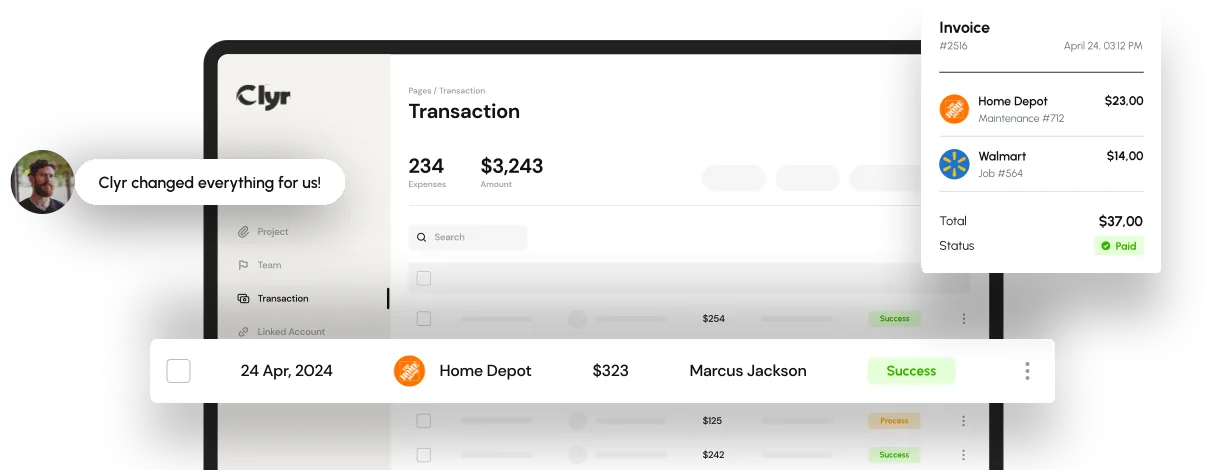
That first step is where Clyr fits, on the cards you already have. The moment a card is swiped, Clyr texts the employee, and they reply with a photo. Coding rules set the GL account (general ledger account), project, property or cost code, and any human edit wins. Scheduled text and email reminders go to the people with open items, listing exactly what is missing.
FAQs
An audit log is one piece of the trail: the record a software system keeps of user actions, such as sign-ins, edits and approvals. The audit trail is the whole chain, including the receipts, invoices and bank records the log points to. A perfect log can still sit on a broken trail if half the receipts were never collected.
The business is. A bookkeeper or software company may hold the records, but the IRS expects the taxpayer to produce them. When you switch bookkeepers or systems, export the ledgers, attachments and change history first. If electronic records replaced your paper ones, Publication 583 says the system must be kept for as long as those records are material to tax administration.
Usually, yes, but the edit should be visible and, if it changes what the approver saw, approved again. Moving a charge to the right job is routine; raising the amount or changing a vendor's bank details should go back through approval. The history should keep the original values either way.
They pull one sample from the ledger and check it against the documents, then a second from the documents and check that each was recorded. Then they look for patterns: gaps in check or invoice numbers, approvals dated after the money went out, round-dollar amounts with no documents, and one person entering, approving and paying the same transaction. That last pattern is a segregation of duties problem, where the work was never split among different people.