
Operating expenses (OpEx) are the recurring costs a business incurs to run day-to-day operations, separate from the cost of producing goods (COGS) or one-time capital investments. Common examples include rent, salaries, utilities, insurance, and software subscriptions. Tracking OpEx separately matters because it shows how efficiently a company runs its core operations, independent of production costs or asset purchases.
That distinction sounds simple until you're staring at a mixed invoice or a subscription that could belong in either bucket. Get the OpEx meaning right and your P&L tells an accurate story about operating efficiency. Get it wrong and it skews margins, tax filings, and every ratio your lender or investor looks at.
What Counts as an Operating Expense?
An operating expense is any cost tied to running the business that isn't part of making the product or buying a long-term asset. That includes selling, general, and administrative costs (SG&A): payroll, rent, utilities, insurance, marketing, and office supplies all fall under operating expenses because they keep the lights on regardless of production volume.
Cost of goods sold sits in a different bucket. COGS covers the direct cost of producing whatever you sell, materials and direct labor mainly, and it moves with revenue. Operating expenses do not scale the same way. A ten-person consulting firm and a two-hundred-person firm both pay rent and insurance, but the ratio of that spend to revenue is what actually signals how lean the operation runs.
Field-based businesses complicate this further. A construction crew's fuel, small tools, and site supplies often get miscoded as job costs when they're really overhead, and that muddies both the job-costing picture and the OpEx total. Purpose-built expense management for construction crews solves this by forcing a category at the point of purchase instead of guessing at month-end.
Common Examples of Operating Expenses
Most operating expenses fall into a short list of recognizable categories. Bookkeepers who standardize a chart of accounts around these buckets spend far less time reclassifying entries later.
| Category | Typical Examples | Cost Behavior |
|---|---|---|
| Payroll & benefits | Salaries, wages, health insurance, payroll taxes | Semi-fixed |
| Occupancy | Rent, property tax, building insurance | Fixed |
| Utilities | Electricity, water, internet, phone | Variable |
| Marketing & advertising | Digital ads, print materials, trade shows | Variable |
| Software & subscriptions | Accounting tools, CRM, project management apps | Fixed |
| Professional services | Legal fees, bookkeeping, consulting | Variable |
| Travel & vehicle costs | Mileage, fuel, lodging, per diem | Variable |
| Repairs & maintenance | Equipment upkeep, office repairs | Variable |
Most operating expenses are deductible in the year they're incurred, following IRS guidance on ordinary and necessary business expenses. For a fuller rundown of what qualifies, this list of deductible business expenses breaks down categories by tax treatment.
Operating Expenses vs Capital Expenditures

The line between operating expenses and capital expenditures comes down to how long the benefit lasts. OpEx pays for something consumed within the year (a utility bill, a month of software access). CapEx buys an asset with a useful life beyond one year (a vehicle, a building, heavy equipment), and it gets depreciated over that life instead of expensed all at once.
The same purchase can land in either category depending on how it's structured. Buying a truck outright is CapEx. Leasing the same truck month to month is usually OpEx. A perpetual software license is often capitalized; a SaaS subscription almost always runs through operating expenses instead.
A property manager splitting utility and repair costs across a dozen buildings runs into a version of this problem constantly: a full roof replacement is capital, but the patch job after a storm is an operating expense, and mixing them up throws off per-property profitability.
Why Operating Expenses Matter for Your Bottom Line
Operating expenses drive your operating margin, the percentage of revenue left after covering both COGS and OpEx. A business can grow revenue and still lose ground if operating expenses climb faster, which is exactly what happens when headcount or software spend outpaces sales.
The operating expense ratio (OpEx divided by revenue) is the quickest gut check. A rising ratio over several months usually means overhead is creeping in unnoticed, often in small subscriptions or field spend that nobody is watching in real time.
Catching that drift requires visibility while the spend happens, not three weeks later during close. That's the case for dedicated expense management software: it keeps every operating expense categorized as it lands instead of arriving as a pile of unlabeled transactions at month-end.
How to Track and Categorize Operating Expenses Correctly
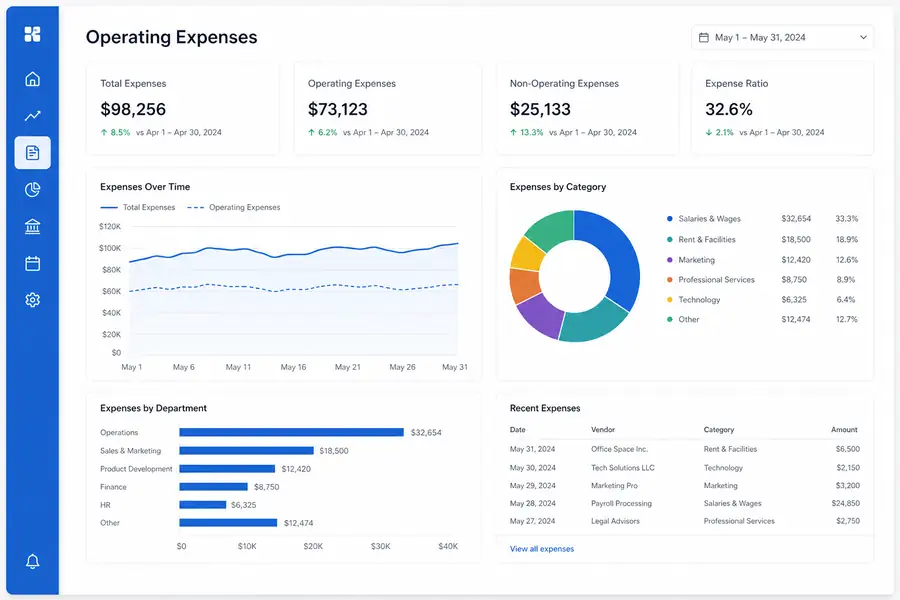
Accurate OpEx tracking starts with a chart of accounts that separates categories cleanly: payroll, occupancy, utilities, marketing, software, and travel, each with its own line instead of a catch-all miscellaneous bucket that hides where the money actually goes. Every purchase should get coded to a category the moment it happens, not weeks later from memory or a stack of paper receipts.
Field teams are usually where this breaks down first. A technician pays for parts at a supply house, a property manager's on-site staff grabs cleaning supplies, and both receipts sit in a glove box until someone finally submits an expense report. By then nobody remembers which job or property the purchase belonged to, and the bookkeeper is left guessing at the OpEx category too.
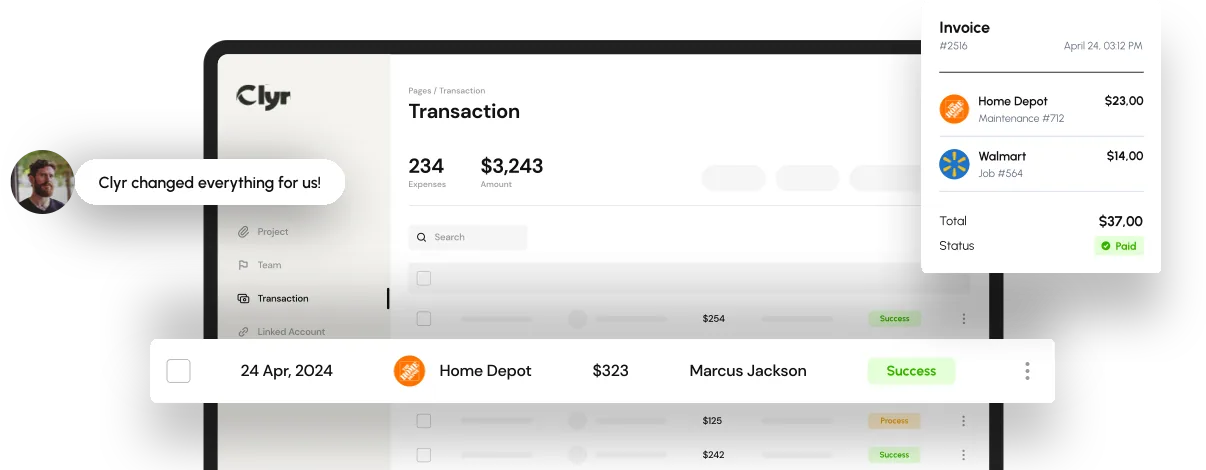
Clyr closes that gap by pairing corporate cards with real-time receipt capture: the moment a card is swiped, the employee snaps the receipt and codes it to a category and job, and the entry syncs straight to QuickBooks instead of sitting in a spreadsheet waiting for reconciliation. For a bookkeeper closing the books for several clients at once, that means operating expenses are already sorted correctly before the close even starts. Teams evaluating a change can book a demo to see the categorization and sync in action.
FAQs
What is the difference between operating expenses and operating costs?
The two terms are generally used interchangeably. Both refer to the day-to-day costs of running a business, like rent, payroll, and utilities, as opposed to the cost of goods sold or capital expenditures.
Are salaries an operating expense?
Yes, salaries and wages for administrative, sales, and support staff are classified as operating expenses. Wages for employees directly involved in producing goods or delivering a billable service are usually recorded under cost of goods sold instead.
Is rent an operating expense or a capital expenditure?
Rent is an operating expense because it pays for the use of a space over a defined period, typically a month, with no lasting asset left on the balance sheet. Buying the building outright would be a capital expenditure instead, since it creates a long-term asset that gets depreciated.
How do you calculate total operating expenses?
Add up every SG&A line item for the period: payroll, rent, utilities, marketing, software, insurance, and similar recurring costs, excluding cost of goods sold and capital purchases. Most accounting software, including QuickBooks, will total this automatically once transactions are categorized correctly, which is why consistent coding at the point of purchase matters so much.