Quick answer: Yes, in most cases. A flat monthly car allowance is taxable income under IRS rules because it is paid without proof of actual business mileage, so it gets added to wages and hit with federal income tax, Social Security, and Medicare. The exception is a properly structured accountable plan, such as a FAVR (Fixed and Variable Rate) allowance, where mileage substantiation keeps the payment tax-free.
That distinction, accountable versus nonaccountable, decides whether an employee keeps the full dollar amount or loses close to a third of it to payroll tax. Here is how the rules actually work, what a taxed car allowance costs a typical field employee, and how to structure one so it does not quietly become a compliance problem for HR and finance.
What Is a Car Allowance?
A car allowance is a fixed amount, usually paid monthly, that an employer gives an employee to cover the cost of using a personal vehicle for work. Unlike a per-mile reimbursement, the amount does not change based on how many miles the employee actually drives that period.
Most car allowances run $300 to $800 a month depending on the role and how much driving the job requires. Sales reps, property managers, and field service technicians use them most, since they are on the road daily but do not drive a company-owned fleet vehicle.
Why Are Car Allowances Taxed?
Car allowances are taxed because the IRS treats most of them as nonaccountable plan payments, which count as regular wages. An accountable plan, an IRS-defined reimbursement arrangement that requires a business connection, expense substantiation, and return of any excess payment, is the only structure that lets a car allowance skip payroll tax.
A flat monthly allowance fails that test because the employee does not have to prove actual mileage or return unused funds. So it lands on the employee's W-2 and gets taxed like any other paycheck: federal income tax, Social Security, Medicare, and in most states, state income tax too. Employers also owe their share of FICA on the amount, a cost that is easy to leave out when budgeting a car allowance program.
Standard mileage rates and accountable plan rules change periodically, so it is worth confirming the current figures directly with the IRS before finalizing a car allowance policy.
How Much Tax Do You Pay on a Car Allowance?

A nonaccountable car allowance typically loses 30 to 40 percent of its value to combined payroll taxes before the employee ever sees it. The exact hit depends on the employee's bracket and state, but the mechanics stay the same everywhere: the allowance gets added to gross wages, then federal, FICA, and state withholding come out like normal pay.
| Allowance structure | Monthly amount | Estimated taxes | Employee take-home |
|---|---|---|---|
| Flat allowance (nonaccountable) | $500 | $150-175 (30-35%) | $325-350 |
| FAVR / accountable mileage reimbursement | $500 equivalent | $0 | $500 |
Over a year, that gap adds up to roughly $1,800 to $2,100 in lost value on a $500 monthly allowance. That is money the employee never actually keeps, even though the company budgeted for the full amount.
Car Allowance vs Mileage Reimbursement: Which Is Taxed?
Mileage reimbursement paid at or below the IRS standard mileage rate is not taxed, because it is tied to actual business miles driven and documented per trip. A car allowance is taxed because it is a flat number disconnected from real mileage.
For field teams logging heavy but uneven mileage month to month, switching from a flat allowance to a per-mile model, or a FAVR plan that combines a fixed vehicle-ownership payment with a variable per-mile rate, keeps the reimbursement tax-free while still covering fuel, maintenance, and insurance. Our guide to cost-effective mileage reimbursement strategies for business travel walks through setting that rate, and optimizing your mileage reimbursement program covers keeping the paperwork clean enough to survive an IRS review.
How to Structure a Car Allowance for Field Teams
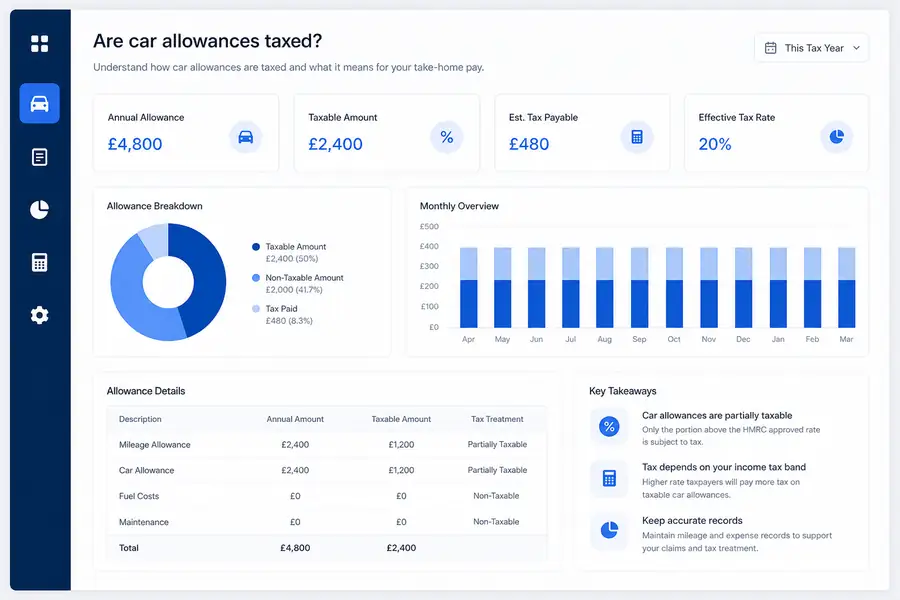
The most tax-efficient car allowance for a field team is a FAVR plan built on real mileage logs, not a flat check. FAVR splits the payment into a fixed monthly amount for depreciation and insurance, plus a variable per-mile rate for fuel and maintenance, and both pieces stay untaxed as long as employees log trips and submit documentation on time.
That is the part most SMBs get stuck on: someone has to collect mileage logs, match them to job sites, and keep records clean enough to pass the accountable plan test.
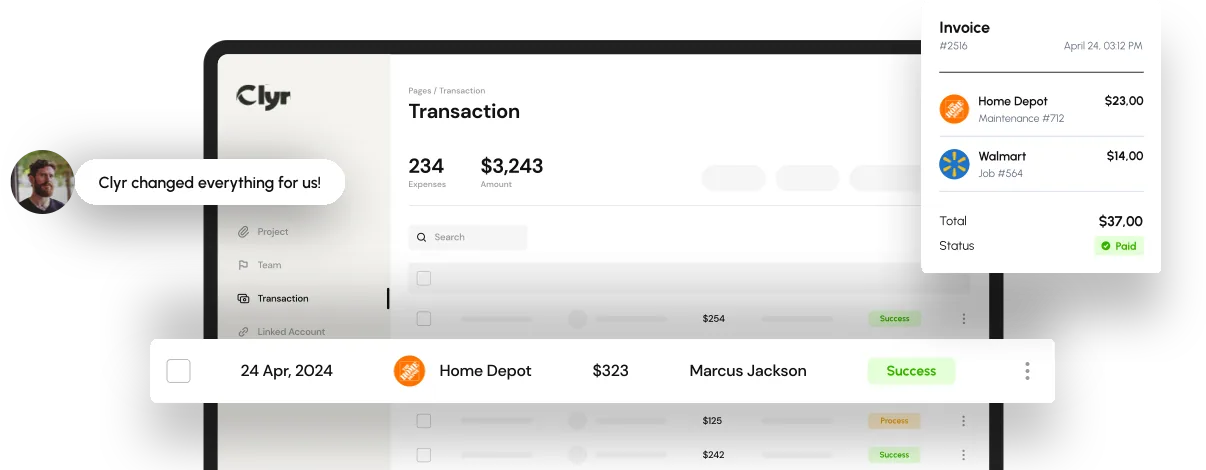
This is where expense management software for field teams does the heavy lifting instead of a manager chasing paper logs at month-end. Clyr captures mileage and fuel receipts in real time from a driver's phone, codes each trip to the right job or property, and syncs the records into QuickBooks so the accountable plan documentation is already sitting in the books before close. Real-time capture plus accounting sync is what keeps a mileage-based program actually tax-free instead of turning into a manual reconciliation project.
Common Mistakes with Car Allowance Tax Treatment
- Paying a flat allowance with no mileage log: this triggers full payroll tax on every dollar, since there is no substantiation to qualify as an accountable plan.
- Mixing allowance and reimbursement in one payment: combining a flat stipend with per-mile pay in a single line item confuses W-2 reporting and often causes the whole amount to get taxed by default.
- Ignoring state-specific rules: a handful of states apply different withholding or reporting requirements to vehicle allowances, so a national policy needs a state-by-state check.
- Forgetting employer-side FICA: companies often budget only the allowance itself and miss the matching payroll tax they owe on top of it.
FAQs
Is a car allowance taxable income?
Yes, in almost every case. A car allowance paid without mileage substantiation is treated as taxable wages, subject to federal income tax, Social Security, and Medicare, and it appears on the employee's W-2 alongside regular salary.
How much tax will I pay on a car allowance?
A typical flat car allowance loses 30 to 40 percent of its value to combined federal, FICA, and state withholding, depending on the employee's tax bracket and state of residence. On a $500 monthly allowance, that usually means $325 to $350 in actual take-home pay.
Can a car allowance be tax-free?
Yes, if it is structured as an accountable plan, such as a FAVR arrangement that ties payment to documented business mileage and returns any excess. A flat, unsubstantiated monthly stipend does not qualify and gets taxed as ordinary wages.
What is a FAVR car allowance?
FAVR stands for Fixed and Variable Rate, an IRS-recognized reimbursement method that pays a fixed monthly amount for ownership costs like depreciation and insurance, plus a variable per-mile rate for fuel and maintenance. Both parts stay tax-free as long as mileage is logged and documented.
Does a car allowance count as a fringe benefit?
No. The IRS treats a nonaccountable car allowance as regular wages, not a fringe benefit, which is why it shows up on payroll and gets taxed the same as salary. If you want to see how automated mileage tracking and accounting sync work for a field team, you can book a demo of Clyr's platform.