What Is a Bank Reconciliation? Steps and Example
A bank reconciliation compares the cash balance in your own books with the balance on your bank statement for the same date and explains every difference, such as checks that haven't cleared, deposits still on the way, bank fees and errors, until both sides show the same adjusted figure.
If your books show $12,400 in checking on March 31 and the statement says $13,150, a $750 check you mailed to a supplier that hasn't been cashed yet explains the whole gap, and both numbers are right.
Why the two balances drift apart
Your bank keeps one record of your checking account. You keep another in your general ledger, the master record of every account in your books. They rarely agree on any given day. Checks take days to clear, and the bank takes out fees nobody typed into the books.
A reconciliation separates harmless timing gaps from real problems, such as a deposit recorded twice or a check you never wrote. It also proves the cash figure on your balance sheet, the report of what the business owns and owes, before anyone relies on it. IRS Publication 583 puts it plainly: "You should reconcile your checking account each month." It belongs early in the month-end close, the routine of finalizing the month's books.
A credit card reconciliation does a different job, matching each card charge to a receipt and the right category or job. Both are kinds of account reconciliation, proving balance-sheet accounts against an outside record.
What causes the differences
Bank-side items are things you've recorded that the bank hasn't processed yet. A deposit in transit is money you deposited and recorded that isn't on the statement yet. An outstanding check is one you wrote and recorded that the payee hasn't cashed. Bank errors, such as another customer's check charged to your account, also go here.
Book-side items are things the bank has processed that you haven't recorded: service charges, interest earned, automatic payments nobody entered and customer checks that bounced. A bounced check is called an NSF (nonsufficient funds) check, and the bank takes the money back out. Your own typing mistakes count as book-side items too.
Only book-side items get a journal entry. Bank-side items fix themselves when checks clear and deposits post, apart from bank errors, which you take up with the bank.
How to do a bank reconciliation, step by step
- Get the statement and a report of your checking account in the books for the same end date. Use the statement's ending balance, not the live online balance, which moves with pending items.
- Tick off deposits. Any deposit in your books that isn't on the statement is a deposit in transit.
- Tick off payments, including checks, debit card purchases and ACH payments (electronic bank-to-bank transfers). Checks in your books that haven't cleared are outstanding.
- Note everything on the statement that isn't in your books, such as fees, interest, returned checks and automatic debits.
- Adjust both sides. Add deposits in transit to the statement balance and subtract outstanding checks. Apply the book-side items to your ledger balance.
- When the adjusted balances match, record entries for the book-side items, save the reconciliation with the statement, and have someone other than the preparer sign off.
If they don't match, check the size of the gap. A gap equal to one transaction usually means it was missed. A gap of exactly twice one transaction usually means it went in on the wrong side. A gap that divides evenly by 9 often means transposed digits, such as $1,486 typed as $1,468.
Worked example: a plumbing company's September reconciliation
A plumbing company with one checking account closes September 2026. The statement shows $48,215.60 on September 30. The general ledger shows $49,620.95. The bookkeeper finds a $6,850.00 deposit of customer checks made on the afternoon of September 30, which the bank posted October 1. Three supplier checks haven't cleared. The statement also has a $30.00 monthly service charge and a $25.00 incoming wire fee that aren't in the books. And check 4466 to a supply house cleared at $1,486.00 but was entered as $1,468.00, so the books understate that payment by $18.00.
| Bank side | Amount | Book side | Amount |
|---|---|---|---|
| Statement balance, Sept 30 | $48,215.60 | Ledger balance, Sept 30 | $49,620.95 |
| Add deposit in transit | +$6,850.00 | Subtract service charge | -$30.00 |
| Subtract check 4471 | -$1,240.00 | Subtract wire fee | -$25.00 |
| Subtract check 4478 | -$3,465.25 | Subtract check 4466 error | -$18.00 |
| Subtract check 4479 | -$812.40 | ||
| Adjusted bank balance | $49,547.95 | Adjusted book balance | $49,547.95 |
The bank side: $48,215.60 + $6,850.00 = $55,065.60. The outstanding checks total $5,517.65 ($1,240.00 + $3,465.25 + $812.40), and $55,065.60 - $5,517.65 = $49,547.95. The book side: $49,620.95 - $30.00 - $25.00 - $18.00 = $49,547.95.
A second way to check it: the starting balances were $1,405.35 apart ($49,620.95 - $48,215.60). The bank side rises by a net $1,332.35 ($6,850.00 - $5,517.65) and the book side falls by $73.00. Together, $1,332.35 + $73.00 = $1,405.35, so the whole gap is explained.
Adjusting journal entries
A journal entry records a transaction with equal debits and credits. In your books, a debit to an expense records the cost, a debit to accounts payable pays down a bill, and a credit to Cash lowers the balance. Your bank's statement uses the words the other way round: a credit there adds money to your account.
The deposit in transit and the outstanding checks need no entry, because they're already in the books and will show up on a later statement, usually October's. The three book-side items do:
| Account | Debit | Credit |
|---|---|---|
| Bank service charges | $55.00 | |
| Cash, checking | $55.00 | |
| Accounts payable, supply house | $18.00 | |
| Cash, checking | $18.00 |
The first entry books both fees ($30.00 + $25.00) as an expense. The second fixes check 4466. That check paid a $1,486.00 bill sitting in accounts payable, the list of bills the business owes, and recording only $1,468.00 left $18.00 open on the bill. The debit to accounts payable closes it. If the check had been written straight to an expense with no bill, you'd debit that expense instead.
Debits total $73.00 and credits total $73.00. The credits lower checking in the books from $49,620.95 to $49,547.95, the adjusted figure.
Mistakes that throw a reconciliation off
- Plugging an unexplained difference into a miscellaneous account buries the problem, and next month starts off wrong.
- Editing or deleting a transaction in a month that's already reconciled changes the opening balance for every month after it.
- The person who writes checks and pays bills also reconciles the account, and nobody else ever looks.
The legal clock on forged checks
Under section 4-406 of the Uniform Commercial Code (UCC), a model set of commercial laws each state passes in its own version, you must "exercise reasonable promptness" in reviewing statements and report any check that was altered or carries a forgery of your own signature. Forged endorsements, the payee's signature on the back, follow other rules. If you're slow and the bank proves the delay cost it money, you can lose the right to make it cover the loss.
When one person forges a string of checks, you can lose claims on later forgeries the bank paid in good faith after you'd had a reasonable time to review and before you reported the first one. Reporting the first forgery stops that clock. If you prove the bank lacked ordinary care (the care a reasonable bank would take) and that this substantially contributed to the loss, the loss is split by each side's share of the failure. If the bank didn't act in good faith, you aren't cut off at all.
The model text also sets an outer limit of one year, regardless of anyone's care, to report a forgery of your signature or an alteration. State versions differ, though: New York still uses an older text with its own limits. And UCC section 4-103 lets a bank vary these rules by contract, as long as it isn't excused from good faith and ordinary care. Some business account agreements cut the reporting window to 30 days. Read yours, check each statement as it arrives, and ask your attorney which rules apply.
Keeping reconciliations quick across clients
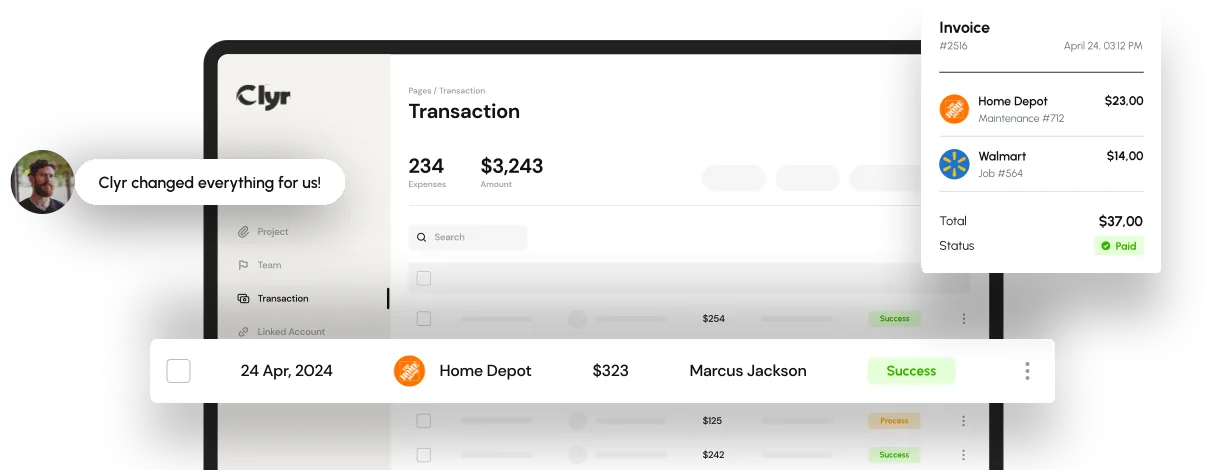
Matching bank transactions goes fast once the bank feed, the automatic import of bank transactions into your accounting software, is connected. The slow part is usually the card spending underneath: charges with no receipt and no job. Clyr connects to the cards a client already has, texts the cardholder at the swipe for a photo of the receipt, and codes each charge by your rules, so expenses sync to QuickBooks or Xero coded and ready to reconcile. The partner portal for bookkeeping firms puts every client in one place.
FAQs
At least once a month, as soon as the statement is available. Busy accounts are easier weekly: ticking off 60 transactions on a Friday beats facing 260 on the third of the month. Sign off the formal reconciliation against the month-end statement, since that's the balance your reports use.
Call the payee first, since the check may be lost. Under the UCC, a bank doesn't have to pay an ordinary check presented more than six months after its date, but it still may. If you void it, ask the bank to stop payment and reissue if needed. If you can't find the payee, the money can become unclaimed property you must report to the state, commonly after three or five years.
No. Matching transactions from a bank feed checks items one at a time. A reconciliation ties the ending balance to the statement, which catches what matching misses, such as a transaction deleted by mistake or an opening balance that changed because someone edited last month.
Leave your books alone. List the error on the bank side of the reconciliation and call the bank with proof, such as your deposit receipt. Booking an entry for a bank error means reversing it later, with a wrong cash balance in between.
Yes, and if anything they need them more. Under cash-basis accounting, income and expenses are recorded when money moves, so the bank account drives almost every number on the profit and loss statement, the report of income and expenses. A missed fee or a doubled deposit changes reported profit directly.