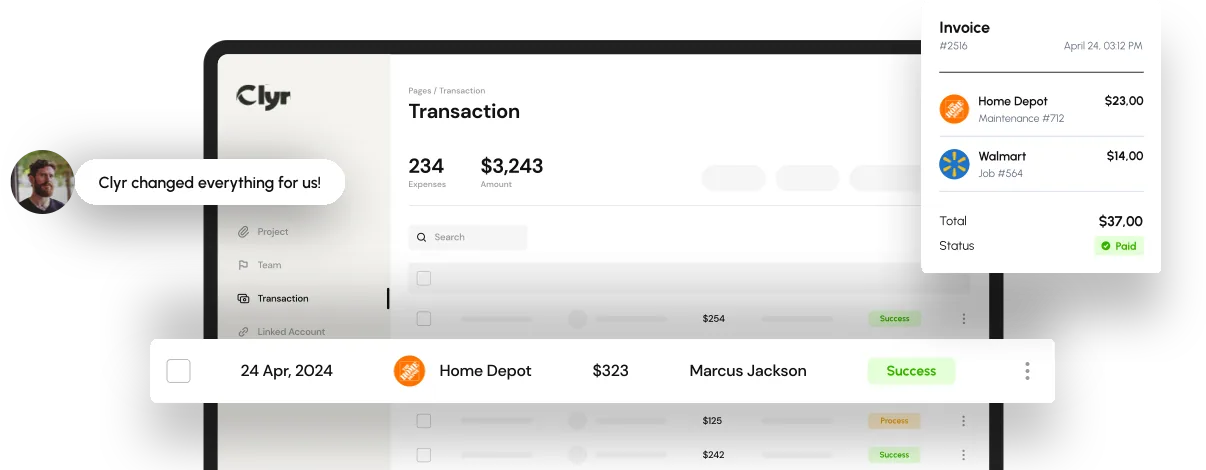

In the digital age, businesses are expected to operate faster, smarter, and more efficiently than ever before. Yet one of the most time-consuming and error-prone processes - managing company expenses - continues to slow teams down. Manual entry, paper receipts, and disconnected spreadsheets remain common, even in tech-forward industries. These outdated methods not only drain productivity but also create financial blind spots that hinder decision-making.
Expense management automation changes that entirely. By combining artificial intelligence (AI), real-time data, and seamless integrations, automated systems like Clyr eliminate repetitive manual work, reduce human error, and give finance teams full visibility into where every dollar goes. What was once a reactive, after-the-fact process becomes a proactive, data-driven advantage.
What Is Expense Management Automation?
Expense management automation uses technology to manage the end-to-end expense process - from receipt capture and transaction categorization to approval workflows and financial reconciliation - without human intervention.
Modern platforms like Clyr integrate with existing financial systems and provide:
- AI-powered receipt capture - Extracting and coding expense data automatically in real time.
- Automated transaction matching - Linking receipts to corresponding transactions and accounts.
- Smart policy enforcement - Applying pre-set company rules to approve or flag expenses instantly.
- Integration with accounting, ERP, and CRM platforms - Ensuring that financial data stays synchronized and accurate.
- Comprehensive analytics - Providing real-time insights into spending behavior, cost control, and budgeting performance.
The result is a simplified process that cuts down on manual labor, ensures compliance, and strengthens financial control across the organization.
Why Automation Is Essential for Expense Management
1. Time Savings and Productivity Gains
Manual expense reporting can consume entire workdays each month for both employees and finance teams. Automating these processes frees up valuable time.
Clyr users report up to 90% reductions in time spent capturing, matching, and approving expenses. Receipts are processed in seconds rather than hours, and finance teams can close books significantly faster - turning once tedious administration into streamlined, high-efficiency workflows.
2. Unmatched Accuracy and Error Reduction
Even the most detail-oriented employee can misplace a receipt or miscode a transaction. Automated expense management removes these vulnerabilities through next-generation OCR (optical character recognition) and AI learning. Each receipt is automatically read, categorized, and validated against predefined business rules. Accuracy rates reach over 95%, helping finance departments maintain precise records and avoid costly reporting errors or compliance violations.
3. Real-Time Financial Visibility
Automation provides finance teams with live data rather than static monthly summaries. With Clyr, every transaction triggers an instant notification, allowing managers to see exactly where money is being spent, by whom, and on what - as it happens. Real-time dashboards consolidate this data, making it easy to spot budget overruns, identify spending patterns, and adjust financial strategies on the fly.
4. Enhanced Employee Experience
Expense reporting shouldn’t be a burden. Automated solutions make the process effortless. Employees can submit receipts directly via SMS, email, or app; the system handles the rest. Faster reimbursements build trust and satisfaction, while the simplicity of use improves compliance. When expense tracking becomes frictionless, participation rates soar - meaning better data for finance teams and fewer missing receipts.
5. Stronger Financial Oversight and Compliance
Automated systems enforce company policies consistently. Spending limits, approval hierarchies, and category rules are built directly into the workflow. Non-compliant transactions are flagged or rejected automatically. This ensures transparency and audit-readiness while protecting organizations from misuse or unapproved expenses.

The Core Components of Automated Expense Management
A robust expense management automation system is composed of several integrated layers:
1. AI-Powered Receipt Capture
Through advanced OCR technology, receipts are scanned, read, and converted into structured data instantly. Clyr’s AI even learns user behavior over time, predicting correct categories and vendors with high precision.
2. Transaction Matching and Categorization
Automation matches each expense to its corresponding credit card transaction or project. This eliminates tedious manual reconciliation and ensures that every cost is allocated correctly.
3. Automated Approval Workflows
Customizable approval flows ensure proper authorization without unnecessary delays. Approvals can be based on rules such as amount thresholds, departments, or vendor types, creating a smooth yet controlled process.
4. Integration with Financial Systems
Integration is at the heart of automation. Clyr connects with over 50 accounting, ERP, and CRM platforms, ensuring a two-way data flow. This synchronization keeps ledgers, projects, and expense reports aligned, reducing duplicate entries and manual rework.
5. Analytics and Insights
Automation isn’t just about efficiency - it’s about intelligence. Real-time analytics transform raw expense data into actionable insights. Businesses can track spend by department, vendor, or project, benchmark costs, and identify saving opportunities to drive profitability.
Real-World Impact: How Businesses Benefit
Construction and Field Service Companies
Managing expenses across multiple job sites is notoriously difficult. Workers often lose receipts or forget to submit them. With Clyr, field staff can capture receipts via text immediately, while AI assigns costs to the correct job or project. This allows companies to maintain accurate job costing and ensure profitability across all operations.
Property Management Firms
For property managers juggling vendor invoices, maintenance expenses, and utility bills, automation is a game changer. Clyr automatically downloads, codes, and pays bills directly through the platform, updating all entries within their property management software. The result: no missed payments and faster financial reporting.
Bookkeeping and Accounting Practices
For accountants, automation simplifies client management. Clyr’s multi-client dashboard enables accountants to handle multiple accounts simultaneously with full visibility, saving hours of administrative time per month while ensuring accuracy and compliance.
Non-Profit Organizations
Non-profits must adhere to strict grant and project accounting standards. Automation ensures every dollar is tracked correctly to its funding source. Clyr’s system matches expenses to specific projects or grants, providing transparency and maintaining compliance with donor requirements.
Common Pitfalls When Automating Expense Management
While automation offers immense value, implementation missteps can limit its success. Common mistakes include:
- Lack of defined policies: Automating unclear expense rules only amplifies confusion.
- Overcomplicated workflows: The goal of automation is simplification - avoid mirroring inefficient manual structures.
- Ignoring integrations: Failing to connect automation with accounting systems leaves gaps in data consistency.
- Undertraining staff: A well-designed system still needs user buy-in and proper onboarding.
The most successful automation rollouts begin with clear objectives, policy alignment, and employee education to ensure adoption across all levels.
The Future of Expense Management Automation
The evolution of expense management is moving from automation to intelligence. The next generation of tools will incorporate:
- Predictive analytics - anticipating future spend patterns and budget risks.
- AI anomaly detection - automatically flagging irregular transactions or outliers.
- Integrated payment automation - handling bill pay, ACH, and credit card payments within the same platform.
- Voice and chat interfaces - allowing employees to log expenses hands-free.
- Deeper ERP integration - connecting financial workflows across every department for unified decision-making.
Expense management automation is no longer a luxury; it’s a foundation for financial agility and operational resilience.
Expert Tips for Implementation
- Start Small, Scale Fast - Begin with a single department or region to refine workflows before expanding organization-wide.
- Define Approval Logic Clearly - Ensure policy rules are documented and integrated into the system.
- Leverage Analytics Early - Use insights to identify inefficiencies and optimize expense policies.
- Engage Employees - Communicate the benefits and provide clear onboarding to encourage adoption.
- Continuously Improve - Treat automation as an evolving process. Monitor KPIs such as processing time, compliance rate, and cost per transaction.
Frequently Asked Questions
- Is expense automation suitable for small businesses?
Yes. Even small teams benefit from automation through reduced manual work, faster reimbursements, and lower administrative costs. - How does Clyr integrate with existing systems?
Clyr offers two-way integration with over 50 leading CRM, ERP, and accounting platforms, ensuring data consistency and real-time synchronization. - Is automated data secure?
Absolutely. Clyr uses bank-grade encryption, strict access controls, and full audit trails to protect sensitive financial data. - Does automation replace accountants?
No. It empowers them. By eliminating repetitive tasks, accountants can focus on analysis, advisory, and strategy - the work that drives real business value. - What ROI can companies expect?
On average, Clyr customers save over $70,000 annually in reduced manual labor, fewer errors, and faster closings - all while improving transparency and employee satisfaction.
Summary
Expense management automation is redefining how businesses control spending, enforce compliance, and plan for growth. Through AI-powered tools, real-time visibility, and deep system integrations, companies can finally replace reactive financial management with proactive, data-driven oversight.
Whether managing field operations, construction projects, property portfolios, or multi-client accounting practices, automation brings precision, speed, and reliability to every financial decision.
With advanced solutions like Clyr, businesses are not just tracking expenses - they are transforming them into strategic insights that drive profitability, efficiency, and long-term success.